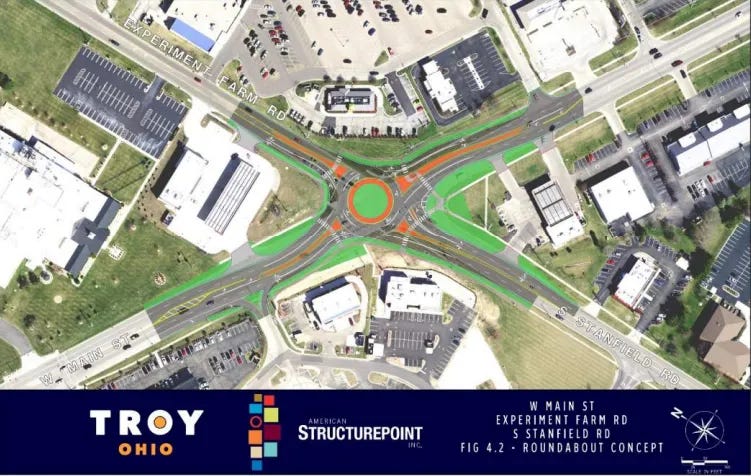
$860,000 DOT Grant Agreement Moves Forward
Vol. IV, No. 7 - Council's Streets and Sidewalks Committee Recommends City Enter into Grant Agreement to Design West Main Street Intersection
For nearly three years, Troy residents have been talking about and asking reasonable questions about what will be happening at the intersection of West Main Street and Experiment Farm Road. This publication has been looking at this project and was among those asking a hard question: what exactly did the City of Troy promise Washington to secure $860,000 in federal engineering funds?
Monday night’s Streets and Sidewalks Committee meeting provided a clearer answer than we expected.
City Service and Safety Director Patrick Titterington confirmed that the grant application was written without committing to any specific design solution. No roundabout. No street widening. The federal funding is flexible enough to cover the engineering costs of either alternative. Given the lack of public communication from City Hall since the grant was awarded in April, it would have been reasonable to assume the design direction was already baked in. Apparently, it isn’t — and that’s worth acknowledging.
The Streets and Sidewalks Committee on Monday night, unanimously approved that the City Council approve the grant agreement and received the $860,000 from the federal Department of Transportation for the final design costs.
But Monday night’s discussion was more than just the $860,000 grant, it was a larger discussion on the roundabout and how the community, and more importantly, City Council, moves foward to resolve this issue.
And as that discussion moves foward, it’s important to take a step back and show how the city got here in the first place. When council voted 9-0 in October 2023 to pursue the roundabout through MVRPC funding, they did so based on what appeared to be ODOT’s own recommendation. Shortly after the grant was awarded in Spring 2024, ODOT reversed course — requiring a brand new study under a traffic analysis manual called OATS, that hadn’t existed when the original studies were done. The roundabout wasn’t exactly a city administration overreach. It was a legitimate response to what ODOT was signaling at the time. The ground simply shifted underneath everyone.
What remains true is that the city has been moving this project forward with limited public engagement, and the pattern of arriving at council meetings with funding already secured is real. But on the specific question of design commitment to Washington, the record is now clearer. And in the same breath, Titterington confirmed what this publication has been pressing for: a public work session will be held before any design direction is finalized.
That meeting was tentatively scheduled for Wednesday, June 24th at 6:00 p.m. at Hobart Arena’s Bravo Room. Put it on your calendar now.
What the Money Is — and Isn’t
The $860,000 covers engineering costs only — not construction. Titterington was explicit that accepting the grant does not commit the city to any particular design. The application was intentionally written without naming either a roundabout or a stoplight upgrade as the preferred solution.
The city also has $2.5 million in committed federal surface transportation funds secured through MVRPC — approved by that unanimous 9-0 council vote in October 2023. The total project is estimated at $4.3 million, with the city’s share coming in around $1 million. So while the new grant doesn’t lock in a design, the broader funding picture has been pointed toward a roundabout for nearly three years. Residents should understand that context going into June 24th.
The Catch-22 Worth Understanding
Here’s where the process gets genuinely awkward, and Titterington didn’t pretend otherwise.
To understand it fully, you need the backstory. The city studied this intersection for years, beginning formal work with American Structurepoint as far back as 2019. When council authorized the MVRPC funding application in Fall 2023, the roundabout was understood to be ODOT’s preferred direction. Council voted 9-0 accordingly. Shortly after the grant was awarded in Spring 2024, ODOT wanted more data — requiring a new feasibility study under its new OATS traffic analysis manual, which postdated all of the city’s previous studies. That study has been completed by American Structurepoint and submitted to ODOT, but as of Monday night’s meeting, ODOT and the consultant are still reconciling the data, analyses, and conclusions. The study isn’t finalized.
And yet here’s the bind: once ODOT accepts the feasibility study, the preferred alternative determines the next level of public input. If it’s a roundabout, ODOT requires a public input meeting before proceeding, which could happen this fall. If it’s a stoplight widening, no public meeting is required — it’s considered a modification of existing infrastructure, not a significant change.
What happens on June 24th is the conversation that should anchor this entire process. American Structurepoint will present both options with full data, council will hear from the public, and residents will have a genuine voice before anything is finalized and submitted to ODOT. The process got here in a roundabout way — no pun intended. But the destination on June 24th is the right one.
Two Options, Honestly Presented
American Structurepoint will present both alternatives at the June 24th session, including the pros and cons of each. It will be intersting to see what the updated data would show. Some of those highlights could include:
Construction cost between a roundabout and a signalized widening is now nearly identical — roughly $20,000 difference was announced at Monday’s meeting.
Long-term maintenance favors the roundabout significantly over a 20-year window.
Safety — the roundabout reduces crash severity; T-bone collisions are far less likely
Pedestrian safety — Structure Point flagged this as the roundabout’s most significant advantage
The current intersection grades out at a D — a failing grade by ODOT standards. This corridor has been on the regional long-range transportation plan for 15 to 20 years and ranks as the 29th highest crash intersection in the MVRPC four-county region. Doing nothing is technically an option, but not a realistic one.
Show Up
At-large Council Member Todd Severt said it plainly Monday night: residents often feel council acts without listening to them. He’s right that the perception exists — and this publication has documented cases where grant agreements arrived pre-packaged before public input had a chance to shape them.
This time is different. The decision is not made. American Structurepoint will present both options. Council will hear public comment. Residents who show up in person will have a direct opportunity to influence which direction the city takes before the project moves forward.
Wednesday, June 24th. 6:00 p.m. Hobart Arena Bravo Room. The meeting will be recorded, but being there in person matters. Troy residents have spent years frustrated by that intersection. The city is now asking what you want to do about it. Answer them.
Announcing our May Community Survey!
Every other month, this publication takes time to ask our readers how they feel about the happenings in their hometown! What are the challenges? What are the opportunities? Is your hometown headed in the right direction? Our survey is the easiest way for you to express your thoughts. Next month, this publication will report out on the results.
Thanks for your time and your participation! It is greatly appreciated!
This is what it looks like when residents stay informed. If you find value in this work, share it with a neighbor, a colleague, or anyone who cares about this community. Paid subscriptions keep it going — $5 a month.
Civic Capacity runs on one thing: readers who believe local journalism matters. If you want to support this work without a subscription, you can now make a one-time contribution through Buy Me a Coffee — or in my case, Buy Me an Iced Tea. Click the button below. Every contribution goes directly into the work you read here every day.


