A Local Foundation Wants to Build Sixteen Homes in Piqua. Here's the Plan.
Vol. III, No. 332 - The Piqua City Commission heard a presentation that didn't ask for a vote, but it wanted to start a conversation.
Rayce Robinson, president of the Paul G. Duke Foundation, introduced a workforce affordable housing initiative targeting a specific site in Piqua — a full city block on Nicklin Avenue — with a specific price point, a specific timeline, and a specific set of partners already at the table. It’s an amibitious plan from a foundation that isn’t looking to make a buck, it’s looking to make a difference.
The commission took it in. Nothing has been approved. No resolution or ordinance is pending. But the plan is now on the record, and residents deserve to know what’s being proposed.
The Problem the Initiative Is Responding To
Robinson didn’t open with the solution. He opened with the data — six years of community surveys, including a 2020 city survey done with the Troy Foundation and a 2023 workforce assessment from Miami County Momentum.
The picture is consistent: affordable housing is the foundational challenge holding back Miami County’s workforce. Thirty-five percent of workers are hourly and economically insecure. Sixty percent of residents commute out of the county for work. In Piqua specifically, nearly half of all households fall into the ALICE category — Asset Limited, Income Constrained, Employed — or below the poverty level. Working people who cannot cover basic living costs, including housing.
What the Duke Foundation Is Proposing
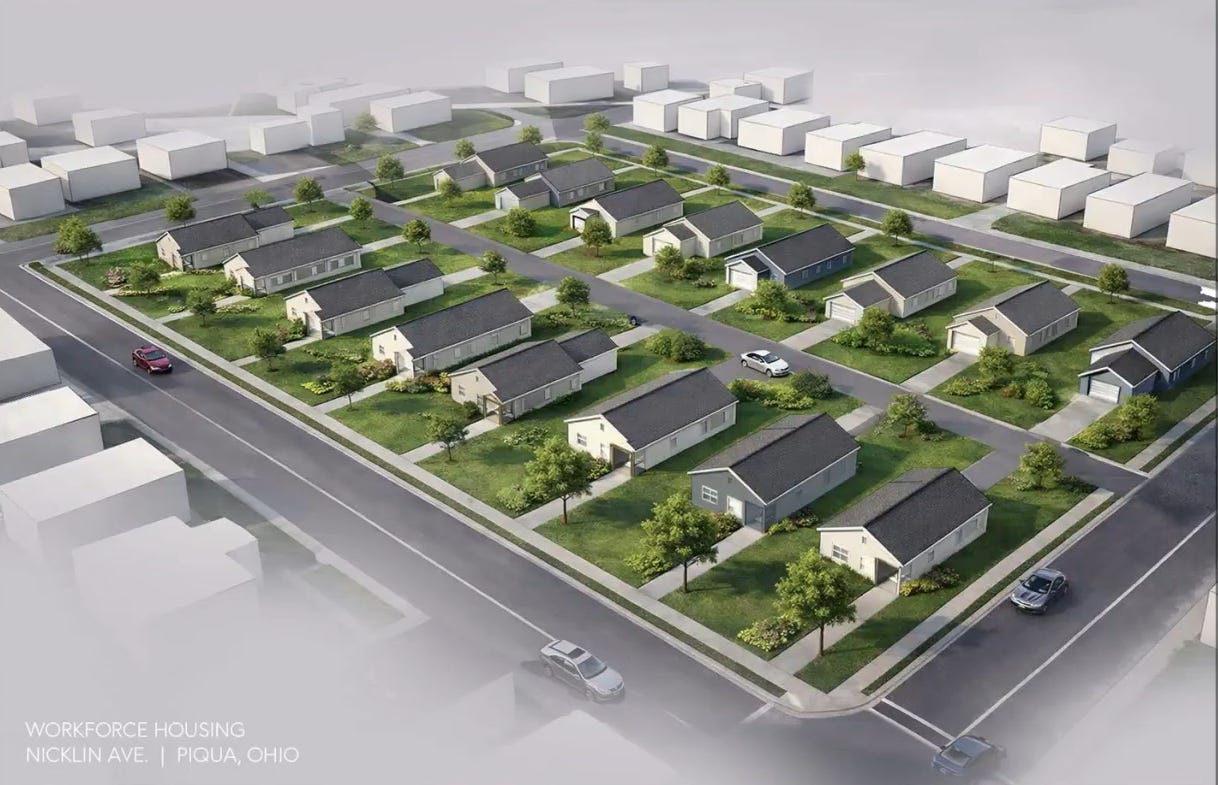
The initiative targets a site on Nicklin Avenue — a full city block made up of approximately 18 originally platted parcels dating to the 1940s and 50s. This is not a greenfield site. It was previously developed as a school, demolished about ten years ago, and environmental remediation has already been completed. The site is clean and ready to build on today.
The goal is 16 single-family, detached homes priced between $200,000 and $220,000 — excluding land acquisition costs. The Duke Foundation plans to purchase the land itself and contribute it to the project, which is what makes that price point achievable. The homes would be primarily single-story with some two-story options, three to four bedrooms, and between 1,300 and 1,500 square feet. Front porches, rear-load parking via a restored historic alley, and facade variety are built into the design principles. The goal is for the homes to feel like they’ve always been part of the neighborhood.
Half of the 16 homes are committed to Habitat for Humanity, which would build six to eight houses over four years using their standard model — 0% interest mortgages for qualifying families, built with volunteer labor and local materials. The other half would be developed by for-profit local builders.
Who’s Involved
The partnership structure is a public-private-nonprofit collaboration. The Duke Foundation would fund land acquisition. The Miami County Land Bank would serve as the conduit, purchasing the property from the city of Piqua and then transacting individual parcels to builders as homes are ready to go. Habitat for Humanity is already committed. Choice One Engineering has completed initial feasibility work and has not identified any significant obstacles. The city of Piqua’s role — including potential utility hookup subsidies — is still being defined.
Robinson was explicit that the framework is designed to be replicable — if it works in Piqua, other communities in the county can follow the same model.
The Timeline
The foundation’s target milestones are aggressive but structured. Site acquisition and replat approval through the planning and city commission are targeted for the third quarter of this year. Infrastructure work on utilities and alley access would follow. The first building permits could be issued as early as this fall, with a groundbreaking ceremony and start of construction on the first homes potentially in September. Habitat for Humanity’s goal is to have a first home completed by the end of the year, with a holiday dedication ceremony to mark it.
Full buildout of all 16 homes is targeted by 2029, with 2030 as a realistic buffer.
What Comes Next
Nothing moves without the city of Piqua’s formal participation — on land transfer, utility infrastructure, and any incentive tools the commission chooses to deploy. Robinson was clear that the commission’s partnership and approvals are essential.
The commission has not yet been asked to vote on anything. That ask is coming. When it does, it will be worth paying attention to how Piqua responds to a plan built around its own stated needs.
This is what it looks like when residents stay informed. If you find value in this work, share it with a neighbor, a colleague, or anyone who cares about this community. Paid subscriptions keep it going — $5 a month.
Civic Capacity runs on one thing: readers who believe local journalism matters. If you want to support this work without a subscription, you can now make a one-time contribution through Buy Me a Coffee — or in my case, Buy Me an Iced Tea. Click the button below. Every contribution goes directly into the work you read here every day.


