


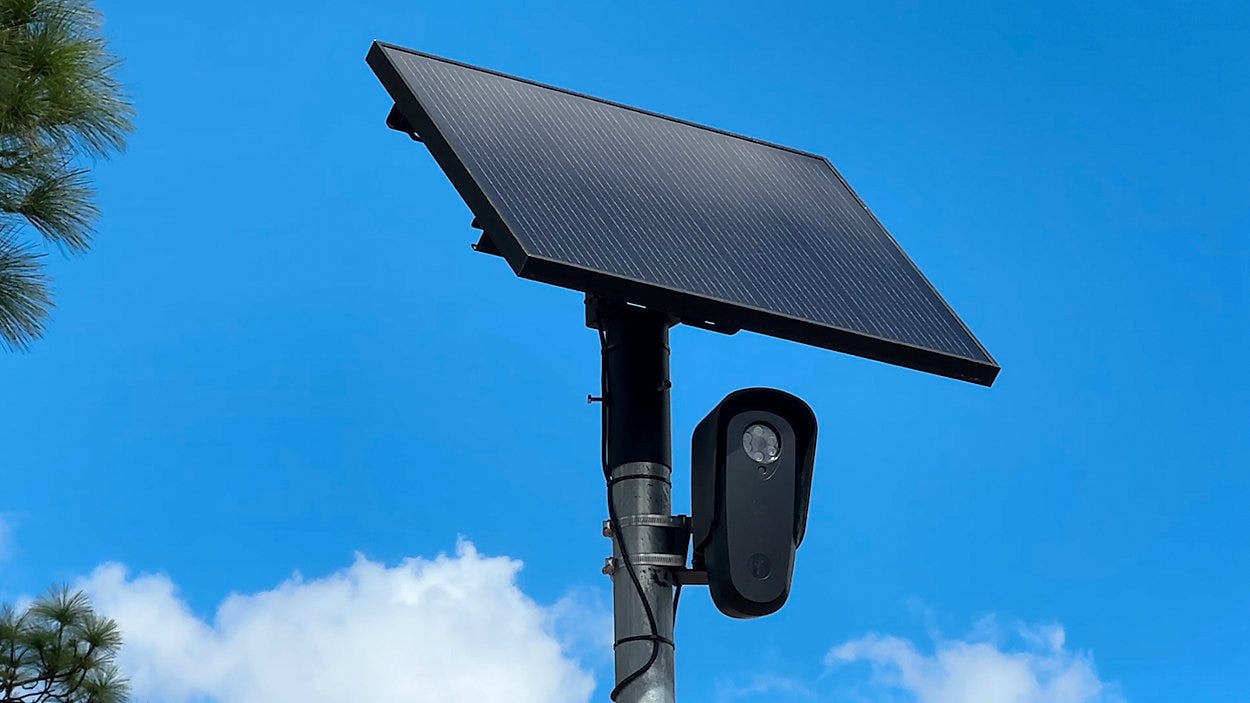
Orginally, Troy’s Police Cheif, Shawn McKinney, was scheduled to talk about flock cameras back in August. But, as the city council was working on their homelessness ordinance, the presentation was put on hold until that issue was resolved.
Monday night that presentation was given and the cheif plainly told City Council that license plate cameras help solve crimes. He also said the department has never audited how they are used. Both facts matter, and residents should hear both.
Troy has 13 Flock cameras. They sit along roads and take pictures of license plates as cars leave the city. The system also notes a car’s color and type, such as a red pickup truck. It does not record a name or an address, according to Chief Shawn McKinney. Flock keeps each photo for 30 days and then deletes it. The chief said an officer can search the system only for a law enforcement reason. Each officer has a personal login, and every search is recorded.
From January through July of this year, officers ran 903 searches as part of 144 investigations. The chief said 42 of those cases ended in an arrest. Nine are still open. He also shared stories. In January, a 75-year-old man with dementia went missing on a freezing night. Camera alerts helped narrow the search, and he was found safe in Indiana. Another search helped officers find a stolen car in a Walmart parking lot. The chief added that car thefts in Troy fell from 20 in 2024 to eight in 2025. He stressed that the cameras do not replace officers, witnesses or detective work. In his words, they are one more tool.
Flock’s default setting searches every network that has been shared with a department. That works in both directions. If Troy shared with a city in Florida, Troy officers could search that city’s cameras, and that city’s officers could search Troy’s. The chief said Troy has now cut back. It shares only with agencies in Ohio and nearby states. He said the change came after public worry. Before that, Troy had shared with a few federal agencies, including a law enforcement unit at Wright-Patterson Air Force Base.
Troy is not alone in rethinking Flock. The Hamilton County Sheriff’s Office ended its use of 75 Flock cameras on October 2nd. It cited data privacy, transparency and local control. Other communities in southwest Ohio such as Lebanon, Monroe and Oxford have either ended or paused their Flock camera program.
The biggest news from the meeting was about checking the system. Council member Bill Twiss asked if the department has an audit process for Flock. The chief answered plainly: it does not. He plans to attend a webinar in the near future to learn how audits work. The chief pointed out that the state audits other police databases, and that the department checks its body cameras at random. Chief McKinney also stated that the Ohio Attorney General is pusing for legislation that would criminalize misuse of the system’s data by law enforcement. Flock is working on tools that would flag strange search patterns. Right now, the system does not do that. Officers must pick a reason for each search from a menu. A case number requirement is expected later.
Several residents said this is the heart of the problem. Some pointed to cases in other states where officers misused license plate systems to follow people they knew. Troy’s policy says misuse can lead to firing, and the chief said criminal charges, such as stalking, would be pursued. Council President William Rozell asked the chief to find out if an outside, independent group could review searches along with the police. Resident Steve Henriksen said the cameras can be useful, but the checking should not be left to the police alone. Mr. Henriksen also stated that the department used to put out periodic updates on how these cameras were used to solve crime; a practice that has gone inactive.
Money came up too. Troy’s first Flock contract, approved in April 2023, cost $57,150 over two years. The 2026 budget sets aside $40,000 to rent the 13 cameras, which is about $3,077 per camera. The city plans to budget $39,000 each year through 2030. Resident Katie Wagner said council was told in 2023 that each camera would cost $2,500 a year. She asked if all 13 are still needed. She pointed to spots where two cameras seem to cover the same area, and she asked the city to show that each camera is worth its price.
There were not votes taken on the program Monday night; this was simply an informative presentation for the City Council and the general public. The chief said the department is working to change its policy to include regular audits. Whether outsiders will be part of that process is still undecided. That leaves room for council action. Council could encourage the department to pick a date for the first audit. Council can be part of the discussion on who will see the results and whether they will be public. Council could ask for a camera-by-camera look at what the city gets for its money.
The cameras will more than likely stay in Troy, at least in the short term. Many residents who spoke said they do not want that tool thrown out. But a tool that helps find missing people and stolen cars can also be misused. The way to keep public trust is to let residents see that someone is checking.
This is what it looks like when residents stay informed. If you find value in this work, share it with a neighbor, a colleague, or anyone who cares about this community. Paid subscriptions keep it going — $5 a month.
Civic Capacity runs on one thing: readers who believe local journalism matters. If you want to support this work without a subscription, you can now make a one-time contribution through Buy Me a Coffee — or in my case, Buy Me an Iced Tea. Click the button below. Every contribution goes directly into the work you read here every day.