Controversial Crawford Street Multi-Use Path Has Come Back
Vol. III, No, 241 - A Project That Failed to Get Funding in 2024 Looks For Funding Here in 2026
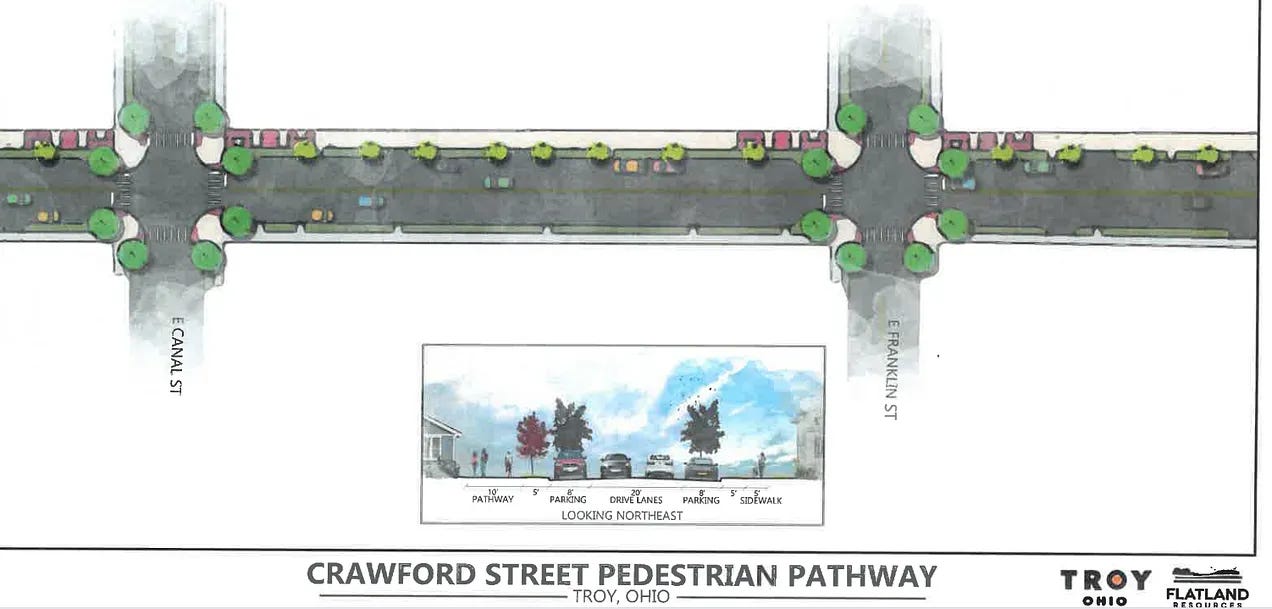
Two years ago, this publication started following a story that continues to shape the conversation about life on Troy’s east side. The City’s idea for a shared-use trail along South Crawford Street — stretching from East Water Street to Herrlinger Park — remains very much alive. Even though the project failed to get grant funding in 2024, a recent public records request shows that Troy’s Development Department still hopes to make it happen. That means residents, especially those who live along South Crawford Street, need to stay watchful and ready to speak up.
A recently filled public records request shows that City staff have indicated to the Ohio Department of Development that it will again pursue money from the State of Ohio’s Community Development Block Grant program, again through the “Neighborhood Revitalization Grant” funding program.
On paper, that sounds like a win for community improvement. But the details matter, and so does the history. The same program turned down Troy’s request in 2024.
Now, ready to apply again, the City went to social media to annouce that it plans to collect income information from east side residents — data that will be used to prove that the project meets federal funding guidelines. While it’s understandable that this data is needed for grant eligibility, many residents may question why they are being asked to share such private details for a project that many have already said they don’t want.
To be fair, not everything about the City’s work on the east side has been controversial. The improvements already made at Herrlinger Park have been welcomed by locals. The new playground, resurfaced basketball courts, and addition of a pickleball complex show real investment in the neighborhood — and were advocated by neighborhood residents when the original grant was requested two years ago. Those are smart, fair improvements that make sense and actually improve quality of life. Everyone can support better parks for our kids and families.
But linking those positive park changes to a $1.7 million shared-use trail down a quiet residential street is where this story turns. City officials say the trail connects to ideas in the “Downtown Riverfront Development Study” and “Complete Streets Plan.” Yet those very studies suggested simple, cost-effective solutions — painted bike lanes or shared-road markings — not a multi-million-dollar construction project that would change the entire profile of the street. Crawford Street has always been a mix of modest homes, wide lanes, and everyday traffic. Turning it into a major bicycle corridor will permanently alter its feel and function.
And despite what planners might say, the bike lane doesn’t make much sense based on how cyclists actually travel on the east side. Most riders go east-west along Franklin or Canal Streets, not north-south on Crawford. Any cyclist will tell you: the fewer stops, the better the ride. But the proposed shared-use path would force riders to stop at nearly every block — at Race, Canal, Franklin, Main, and Water Streets. That hardly sounds enjoyable to anyone on a bicycle.
Then there’s the question of space. Crawford Street has a 60-foot right-of-way, which includes 40 feet of pavement and sidewalks on both sides. To make room for the new 10-foot trail, five feet of street width would disappear. That may not sound like much, but it matters when heavy vehicles, including fire trucks, need to navigate intersections near the Race Drive underpass. No one wants road safety to take a back seat to an unnecessary construction project.
Meanwhile, property values on the street have soared — up an average of about 55% in the past three years. That’s good news in one sense, but it also means higher property taxes for longtime residents. And when those same homeowners hear about a “Neighborhood Revitalization” project that could bring even more change and expense, it’s fair for them to ask: how much revitalization can we afford?
The truth is, there’s still time to shape what happens next. This is a long-term effort, and the City’s latest move to seek new grant funding is only one step; City Council will still need to approve a resolution allowing the City Staff to apply for funding. Residents should take advantage of opportunities to comment, question, and challenge the proposal when it comes back for City Council action. Those voices matter — especially the ones from people who walk, drive, and live on these streets every single day.
This publication has been committed to this story from the very beginning, not to stir division but to promote understanding and transparency. Revitalization should serve residents, not sidestep them. As the City prepares its next application, now is the moment for east side neighbors to talk with one another, share facts, and hold local leaders accountable. Because when residents pay attention and make their voices heard, the direction of a project — and the future of a neighborhood — can change.
Announcing our January Community Survey!
Every other month, this publication takes time to ask our readers how they feel about the happenings in their hometown! What are the challenges? What are the opportunities? Is your hometown headed in the right direction? Our survey is the easiest way for you to express your thoughts. Next month, this publication will report out on the results.
Thanks for your time and your participation! It is greatly appreciated!
A New Way to Support This Work
Our readers and subscribers have been asking for a new way to support the work being done here at Civic Capacity! Some of our readers do not like the idea of having to sign up for another subscription service. Some of our subscribers occasionally want to give more support through a one-time transaction.
Civic Capacity is partnering with “Buy Me A Coffee” to give our readers, subscribers and friends an opportunity to give one-time support to Civic Capacity. Personally, I don’t like coffee, but I will never turn down a nice iced tea. If you feel compelled to support this effort, just click the button below.
Thanks for reading today’s Civic Capacity Newsletter! Please feel free to share this information with your friends and neighbors.
Also, please consider subscribing to our work. If you are a free subscriber, please consider becoming a paid subscriber. For less than $1 a week, you can get timely and conversational updates about the decisions that are impacting you and your community!


I gotta disagree with you on this one. I think that this is one of those projects that a lot of people have a gut reaction against when they first hear about it, but will end up liking once they get to try it out.
(It reminds me of congestion pricing in NYC - it had a lot of hate early on, but now there's nearly universal agreement within the affected area that it was a massive improvement. Most of the folks who are still against it haven't actually experienced the change.)
Is there a “picture overlay” that can be put on the map that shows what City wards are involved on this east side survey? I’m curious what ward council members are impacted by this project. Thanks.