

Decision Looms for West Main Street Roundabout
Vol. IV, No. 49 - City Council will again meet as a Committee of Whole Monday Night

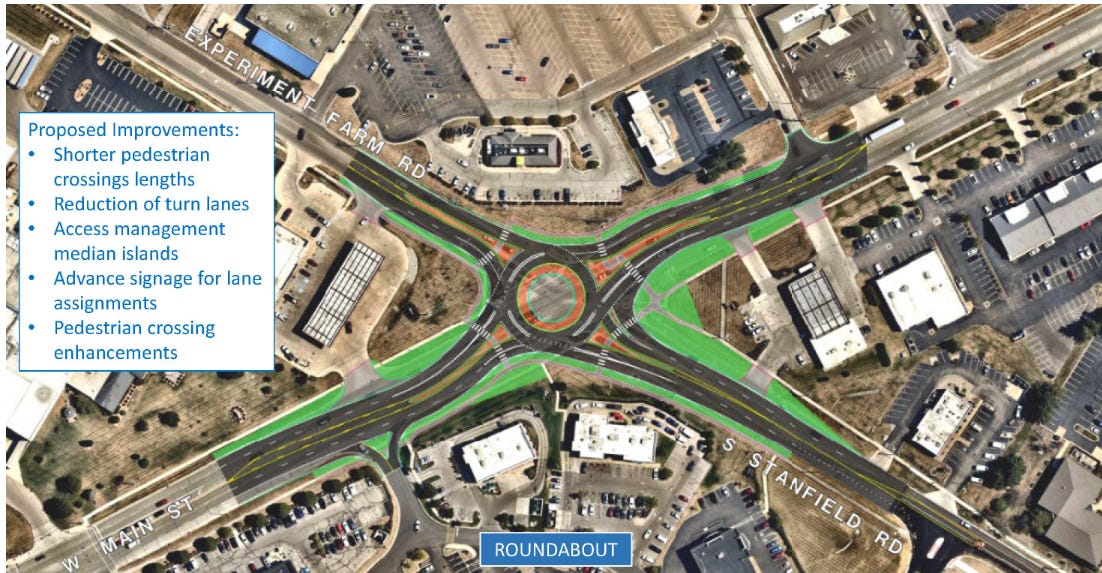
On July 13th, Troy’s City Council will meet as a Committee of the Whole. Years of discussion and study on the West Main Street/Experiment Farm Road/South Stanfield Road intersection are finally coming to a head, as council is expected to decide what design they will recommend for this instersection. The meeting begins at 6:00 p.m. in Council Chambers at 100 South Market Street.
This comes on the heels of last month’s two‑and‑a‑half‑hour session at the Hobart Room, where roughly 80 residents listened to consultants and city staff unpack years of crash data, delay tables, traffic simulations and cost estimates. It also follows a wave of social‑media posts from public officials trying to “educate” residents about roundabouts.
Most of that “education” has focused on how to drive through a roundabout or the history of roundabouts. Very little has wrestled with the actual numbers behind the consultants’ recommendation to build one here instead of installing a better signal. Teaching people how to navigate a circle is helpful. But failing to have a frank, data‑driven conversation about this roundabout, at this time, would have been much more beneficial to residents.
One can speculate why that conversation never happened. It’s largely because the data to back up the roundabout doesn’t really exist.
Every other month, this publication asks readers how they think the community is doing. This month, we added a special question about this project:
“Should the city put in a roundabout at West Main Street and Experiment Farm Road/South Stanfield Road?”
Readers had five options:
No, I don’t like roundabouts and I don’t want one here.
No, I like roundabouts, but this location doesn’t make sense.
Maybe, I need more information.
Yes, I’m not a fan of roundabouts, but I understand why we should put one here.
Yes! I love roundabouts and putting one here would solve more problems than it creates.
At the time of publication, 45 residents had responded. The most common answer – 31 out of 45, or 69 percent – was option 2: “I like roundabouts, but this location doesn’t make sense.” It’s fair to say Troy residents are more than willing to support roundabouts in principle, and even at this intersection – if a strong case can be made.
Right now, the numbers don’t make that case.
The consultant’s crash chart shows 25 total crashes at this intersection in 2024, including 2 injury crashes – the lowest injury count in the three‑year study period. (The police department’s annual report lists 20 crashes for 2024, which raises its own questions, but the trend of lower injuries holds either way.) At the Hobart Arena smeeting, the consultants openly acknowledged that total crashes at this intersection may increase if it is converted to a roundabout, as drivers get used to the new geometry.
We don’t have to look far for an example. Crashes at the McKaig / Dorset roundabout have increased compared to the four‑way stop that was there before, with 14 crashes in 2025 alone. Those crashes tend to be property‑damage only, not serious injuries, but they are still crashes residents experience.
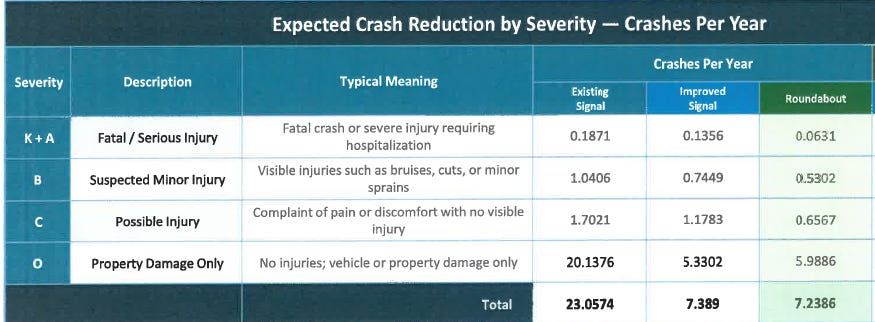
The consultants’ own projections for serious and minor injuries at West Main are expressed as annual averages. Under the existing signal, they estimate 0.187 fatal/serious injury crashes and 1.04 minor injury crashes per year – about 1.22 injury crashes annually. With an improved signal, that drops to roughly 0.88 injury crashes per year. With a roundabout, the estimate falls further to about 0.59 injury crashes per year.
Crashes, of course, don’t happen in decimals. They happen in whole numbers. My Troy High School math tells me that under all three scenarios – existing signal, upgraded signal, and roundabout – we are still talking about roughly one injury crash per year on average. That makes the safety improvement real, but modest, and closer to marginal than transformational.
The traffic story is similar.
The consultants are right that travel times improve for drivers approaching from the north and south. Their delay table shows northbound Stanfield dropping from 67.4 seconds of delay per vehicle under “no build” to 42.5 seconds with an improved signal, and down to 26.5 seconds with a roundabout – a 61 percent reduction compared to today. Southbound delay drops from 35.6 seconds to 28.1 seconds under an improved signal and 28.2 seconds with a roundabout.
Those are real improvements for drivers sitting on Stanfield and Experiment Farm, waiting to turn onto West Main.
But the story looks different if you’re already on Main Street.
According to the same table, eastbound delay on Main Street increases from 18 seconds today to 36.1 seconds with a roundabout – more than a 100 percent increase. Westbound delay rises from 17.6 seconds to 19.4 seconds. Overall intersection delay goes from 28.2 seconds per vehicle today to 27.0 seconds with a roundabout. With an improved signal, that overall delay drops further to 25.0 seconds.
Put plainly: if you care about total intersection delay, the signal alternative performs better than the roundabout. The real delay relief comes from new signalization and turn lanes, not the circle in the middle.
When you put the crash and delay numbers together, the consultants’ own data suggest:
Safety improvements from a roundabout at this specific intersection are going to be barely noticable, not dramatic – and the improved signal also yields a meaningful reduction in projected injuries.
For overall traffic flow, the best tool is a modernized signal with better hardware, timing, turn lanes and access management, not a way of forcing everyone to drive through a geometry that doesn’t match the rest of the corridor.
None of this is based on speculation. These are the numbers presented on June 24.
Perhaps the biggest concern the community should have is how long this will take and how traffic will be maintained. A project of this magnitude could run a year or more, and the consultants freely admitted that traffic has to be maintained through the intersection given current volumes. That means another extended construction zone on West Main – right after a downtown closure, the earlier West Main reconstruction, a summer of ramp closures on the highway, and a new project that will tear up the Public Square.
At what point do residents and businesses get to say “uncle” before someone in City Hall hears them?
When given the chance to weigh in, nearly 70 percent of Troy readers told this publication they like roundabouts in general – they just don’t think this one makes sense at this location, at this time. Regardless of what council decides on July 13, the conclusion of this debate will tell us something important about whose values are being heard, and which problems we are actually trying to solve.
Regardless, one of the last times to have a robust discussion on this topic is going to be on Monday night. It’s important our residents take advantage of it.
Announcing our July Community Survey!
Every other month, this publication takes time to ask our readers how they feel about the happenings in their hometown! What are the challenges? What are the opportunities? Is your hometown headed in the right direction? Our survey is the easiest way for you to express your thoughts. Next month, this publication will report out on the results.
Thanks for your time and your participation! It is greatly appreciated!
This is what it looks like when residents stay informed. If you find value in this work, share it with a neighbor, a colleague, or anyone who cares about this community. Paid subscriptions keep it going — $5 a month.
Civic Capacity runs on one thing: readers who believe local journalism matters. If you want to support this work without a subscription, you can now make a one-time contribution through Buy Me a Coffee — or in my case, Buy Me an Iced Tea. Click the button below. Every contribution goes directly into the work you read here every day.