How Do We Get Good Government In A Trust-Less Society?
Vol. III, No. 341 - An Angry Electorate Leaves Us Searching For Answers
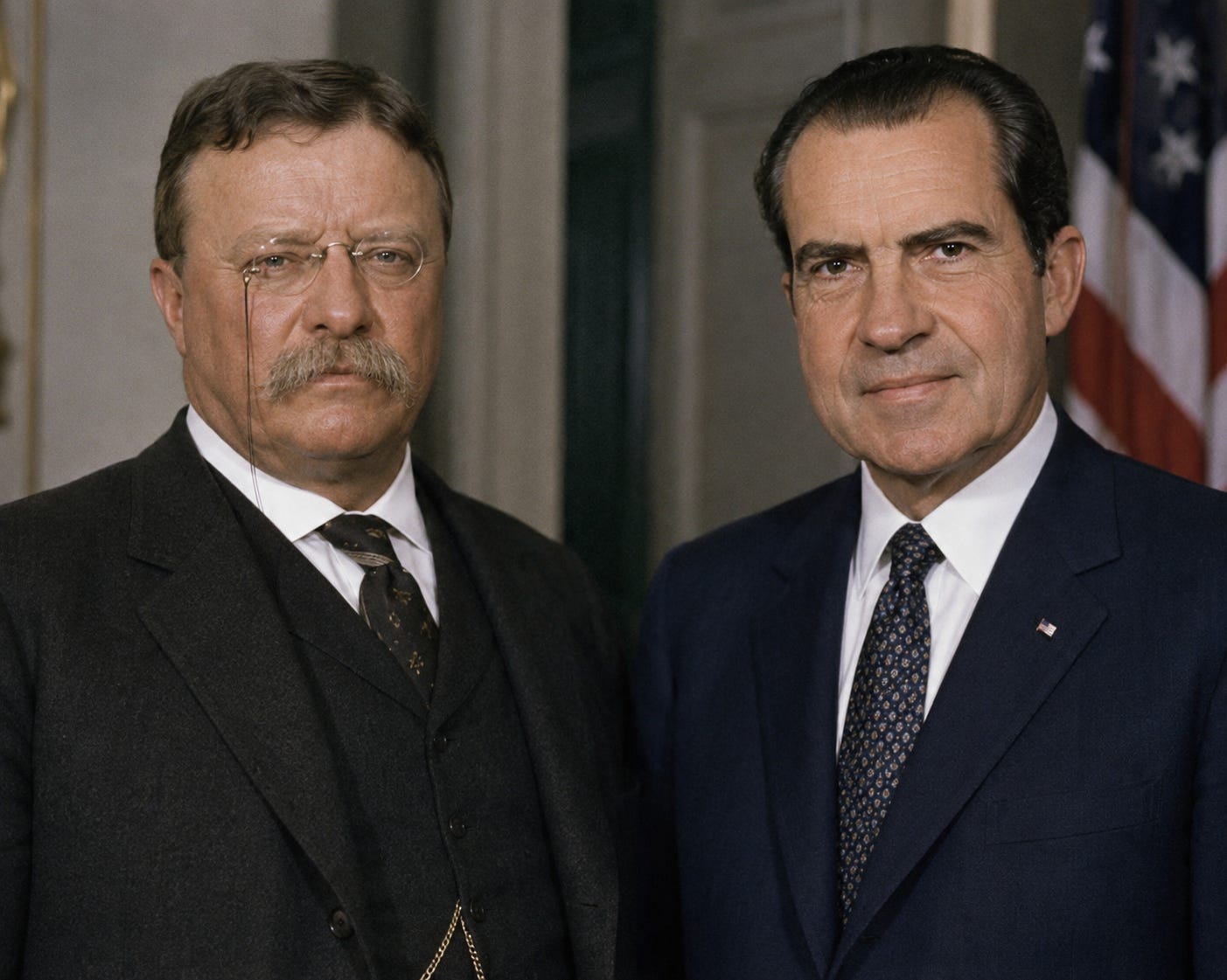
The idea of “good government” isn’t new. It’s been around for more than a century, emerging out of a time when American cities were growing fast, politics was often transactional, and public trust was thin. Reformers in the Progressive Era looked at the gap between what people were promised and what they actually experienced and decided that government needed a reset, not just a tune‑up. National leaders like Theodore Roosevelt and organizations such as the National Municipal League pushed for a different kind of local government—one built on transparency, professionalism, and systems that could outlast any single personality or administration. Many of the reforms they championed are still in place today. In a sense, they built the floor we stand on now.
But in too many communities, including right here in Miami County, we are still living at that floor level. The checkboxes get filled: budgets are adopted, meetings are held, audits are filed, capital projects move forward. The machinery turns, but residents are often left with a familiar feeling: decisions are being made, money is being spent, but the “why” and “how” remain somewhere out of view.
Good government, at least as it was defined a century ago, was about ending corruption and establishing order. Better government in 2026 has to be about something more: performance, openness, and the willingness to show people exactly how well their government is working—and where it is falling short.
The recent 0.5% sales and use tax levy for a new county jail is a good example of where this tension shows up. On paper, this was not a flashy project. A jail is nobody’s favorite public service, but it is absolutely necessary. To their credit, the Board of County Commissioners and the County Sheriff did something many communities never see: they opened the doors and showed residents the problem. Thousands of people walked the halls of a facility built in the 1970s, saw the mechanical doors, handled the keys the size of index cards, and heard the case for why a building designed five decades ago doesn’t work for the kind of system we expect today. That level of access would have been unheard of in an earlier era, when “trust us” was considered sufficient. And yet, it still wasn’t enough to get the levy over the finish line.
Part of the reason is structural, and part of it is emotional. Property tax bills go out twice a year, and each time they arrive, the numbers feel a little higher and a little heavier. For residents whose wages haven’t kept up with the cost of everything else, those bills are not abstract—they are a direct threat to already fragile household budgets. Tax increases land in an environment where social media is full of narratives painting government as wasteful at best and predatory at worst. When your own financial position feels shaky, taxes are the one line item you can try to fight, the one place where saying “no” feels like control. It’s not surprising that the levy failed. What’s concerning is how familiar that reaction has become.
We also can’t ignore the long shadow of distrust. The average person in Miami County today was born around 1984, a full decade after Richard Nixon left the White House, but they grew up in a political culture shaped by Watergate, Iran‑Contra, government shutdowns, and a steady rhythm of scandals and disappointment. For many, government has never really recovered its standing as a trusted institution. Taxes aren’t viewed as the price we pay for a civil society; they feel like a never‑ending ransom note that keeps arriving no matter how carefully you try to manage your own finances. The hard truth is that both sides of that story contain more truth than most of us care to admit.
Police, fire, schools, roads, parks—none of it is free, and the costs rarely go down. There are efficiencies to be found, but they usually require tackling sacred cows that no one really wants to touch. Around here, one of the most obvious examples is the fact that we have nine school districts in a county of roughly 110,000 people. That structure carries real, ongoing cost, and any attempt to rethink it triggers immediate fear, nostalgia, and political backlash.
At the same time, the federal government has never met a dollar it didn’t want to spend, and the state government has never met a dollar it is loathe to collect. All this means responsibilities for real and tangible government services are drifting downward to local governments, while the tools to raise revenue are tightly constrained and increasingly unpopular. Local officials end up in the most precarious seat of all: asked to do more, and to ask a smaller, finite population to pay for it.
This is where the old Good Government floor is no longer enough. Passing clean audits, following the Open Meetings Act, and running legal levy campaigns are the baseline. The next step is far harder: showing residents, in plain numbers and clear narratives, what they are getting for every dollar and what it costs to keep systems from failing in slow motion. “We are investing in infrastructure” is not the same as publishing pavement condition scores over time. “We are committed to public safety” is not the same as sharing response times, recidivism data, and staffing levels. “We are being fiscally responsible” is not the same as opening the books in a way that a normal working person can make sense of.
Ohio’s Home Rule amendment of 1912 gave communities the authority to shape their own structures and policies instead of relying entirely on a one‑size‑fits‑all model from Columbus. That autonomy is a powerful tool because it allows us to build systems that actually match local needs. It also removes a lot of excuses. If we don’t like how things are working, we cannot blame state law for everything. We have the power to rethink our structures, our processes, and our communication. The question is whether we will use that power to defend the status quo or to open things up, test our assumptions, and bring residents into the process in a more meaningful way.
Better government will require more than tours of broken facilities and more than one‑page levy fact sheets. It will require a sustained commitment to making local government easier to see and easier to understand, even when the information is uncomfortable. It will require residents to bring curiosity instead of automatic cynicism, and leaders to respond with data instead of defensiveness.
If we truly believe that better informed residents produce better leadership and better outcomes, then we know what has to happen next. We have to move beyond the minimum standard of “good” government and build something more honest, more transparent, and more responsive to the people who live here—starting with hard conversations about what we can afford, what we truly value, and how we are going to pay for both.
Announcing our May Community Survey!
Every other month, this publication takes time to ask our readers how they feel about the happenings in their hometown! What are the challenges? What are the opportunities? Is your hometown headed in the right direction? Our survey is the easiest way for you to express your thoughts. Next month, this publication will report out on the results.
Thanks for your time and your participation! It is greatly appreciated!
This is what it looks like when residents stay informed. If you find value in this work, share it with a neighbor, a colleague, or anyone who cares about this community. Paid subscriptions keep it going — $5 a month.
Civic Capacity runs on one thing: readers who believe local journalism matters. If you want to support this work without a subscription, you can now make a one-time contribution through Buy Me a Coffee — or in my case, Buy Me an Iced Tea. Click the button below. Every contribution goes directly into the work you read here every day.


