If It Ain't Broke, Let's Fix It
Vol. III, No. 310 - Is there something wrong at the Heywood School?
Something interesting came up at last Monday’s Troy City Council meeting — and it’s worth talking a few minutes to discuss.
During Council Member Comments, Councilmember Susan Westfall brought up a recent letter to council from the Miami County Metropolitan Housing Authority. The letter expressed interest in using former school sites — like the old Heywood School property — for senior housing. That’s a well-documented need in our community, and it’s a worthy conversation to have.
But then things took a turn.
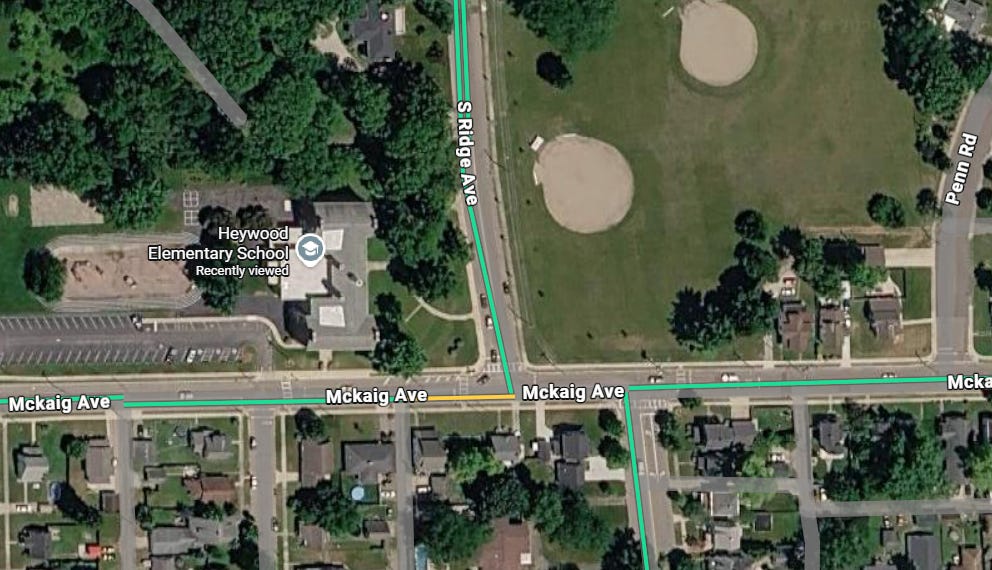
The City’s Service and Safety Director mentioned there were complicating factors involved in putting senior housing on that site. When pressed, one of those factors turned out to be the intersection of McKaig Avenue and Ridge Avenue. Apparently, reconfiguring that intersection has been on someone’s drawing board at City Hall for “five to ten years.” The intersection was also described as “poorly engineered.”
That’s a noteworthy claim — and it raises some fair questions.
This Isn’t a New Conversation
This intersection has come up before. If my memory is corect, about 30 years ago, there was talk of eliminating it — but that plan would have required removing two ball fields at Heywood Park, right next to the school. That idea was wisely set aside. The community made a sensible choice to protect a public space that families used and valued.
Now, with the school on it’s way to being gone, it sounds like the intersection redesign idea may be back. And while the school site’s future is still being sorted out — though there is little doubt that some type of residential use will be there — the Service and Safety Director himself acknowledged at the meeting that losing the two ball diamonds might not be ideal. So the trade-offs haven’t disappeared. They’ve just changed shape.
Which brings up the obvious question: Why is this intersection being targeted for a fix right now?
What Does the Data Actually Say?
Here’s where the recent Troy Police Department’s 2025 Annual Report is worth looking at closely.
The report listed the top three crash locations in Troy for 2025. The intersection of McKaig Avenue and Ridge Avenue is not among them. In other words, the department’s own data doesn’t identify this intersection as a particularly dangerous spot.
That’s meaningful. If an intersection doesn’t show up as a safety concern in the city’s own traffic data, it’s fair to ask what problem, exactly, we’re solving.
A Roundabout Lesson
The same annual report does highlight something that deserves attention. The roundabout at McKaig Avenue and South Dorset Road — a relatively recent construction project — is now the third-highest crash location in the entire city, with 14 crashes in 2025. The report notes it was previously unranked as a hotspot.
That doesn’t necessarily mean the roundabout was the wrong call. Anyone who drove that intersection before knows it could be a chaotic mess — multiple lanes converging on a four-way stop with no clear right-of-way. Traffic backed up. Confusion reigned.
But the data opens up a reasonable question: Did that solution create new problems? And if so, what can we learn from it before we start re-engineering another intersection nearby?
Slow Isn’t Broken
An intersection that’s more than a century old — one that makes drivers slow down and pay attention — isn’t automatically “poorly designed.” Sometimes a little friction in traffic is a good thing. It forces awareness. It can protect pedestrians, cyclists, and kids walking to the park.
The real standard for any street improvement should be: Does it make things safer and better for everyone — not just drivers moving faster?
Before any redesign moves forward, the community deserves to see the studies. What does the data show? Who benefits? Who might be affected? Will it actually improve safety, or just improve the flow of cars?
A Conversation Worth Having — Publicly
Troy is a city with character. Some of that character lives in its older streets and public spaces — places that weren’t built to today’s engineering standards but have served generations of residents just fine.
That’s not an argument against progress. It’s an argument for thoughtful progress — the kind that starts with real data, includes the community, and weighs all the trade-offs before a concept drawing becomes a construction contract.
This conversation shouldn’t be happening behind closed doors at City Hall. It should be happening with the people who live here.
This is what it looks like when residents stay informed. If you find value in this work, share it with a neighbor, a colleague, or anyone who cares about this community. Paid subscriptions keep it going — $5 a month.
Civic Capacity runs on one thing: readers who believe local journalism matters. If you want to support this work without a subscription, you can now make a one-time contribution through Buy Me a Coffee — or in my case, Buy Me an Iced Tea. Click the button below. Every contribution goes directly into the work you read here every day.


