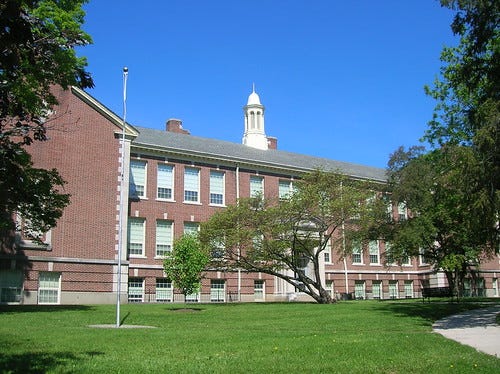
Old Schools, New Uncertainties
Vol. III, No. 340 - Why Neighbors Need a Real Seat at the Table
When Troy voters approved the 2023 school levy, most people thought they were saying yes to new schools, yes to tearing down the old ones, and yes to getting those old sites “cleaned up” for the future. The message was simple enough on the ballot, but the consequences are now landing squarely in a handful of very specific neighborhoods—Ridge Avenue, the city’s East Side, and the Southwest Historic District—without those neighbors ever having been asked what they actually want to live next to.
That disconnect showed up plainly at Monday night’s City Council meeting. A Ridge Avenue resident came asking what sounded like a basic question: did we vote to demolish these buildings and end up with green space, or are these sites being lined up for subsidized or senior housing without us at the table? The honest answer right now is that the legal paperwork points one direction, while the community conversation is starting to drift in another—and the people who live closest to the properties are lagging behind both.
The Deal Made In The Beginning
In December 2023, Council approved a Memorandum of Understanding (MOU) with the Troy City Schools and the Board of Park Commissioners through Resolution R‑64‑23. That MOU set up a land swap: the City and Park Board would convey Hook Park and Campbell Park at Cookson so the schools could build new buildings, and in return, the schools would demolish Van Cleve, Heywood, and Kyle and give those sites back to the City in “shovel‑ready” condition by the end of 2027.
The MOU was explicit that it was an “expression of mutual intent,” not a binding contract, but Council later passed Ordinance 32‑24 authorizing the Director of Public Service and Safety and the Park Board to execute transfer agreements and “take all further necessary actions” to carry out that MOU. Those transfers have begun; the parks are already in school district hands so they can keep their building project moving forward.
All of this happened with virtually no targeted process aimed at the people most affected: neighbors who are losing parks and ball diamonds now, and neighbors who will live next door to whatever replaces these school buildings later.
“Shovel‑ready” is Not the Same as “permanent green space”
Many neighbors heard talk of “shovel‑ready” and “green space” and understandably believed that meant the sites would become passive, park‑like areas for the foreseeable future. In reality, “shovel‑ready” simply means cleared, remediated, seeded land with clean title that is ready for new construction when the City (or its development arm) decides to act.
The MOU requires the school district to remediate and demolish Van Cleve, Heywood, and Kyle and then convey those vacant properties to the City by the end of 2027. These agreements do not say those parcels must remain green space, or that they must be parks, or that they must be housing. Those are future policy decisions.
Right now, the City Administration’s operating assumption is that the sites will be handed off “shovel‑ready” and then likely placed into the hands of the Community Improvement Corporation (CIC), which can hold and sell real estate. Once Council releases those properties to the CIC, its direct leverage over what ultimately gets built narrows considerably.
Housing Needs Versus Neighborhood Voice
Into this murky picture walked a legitimate community need. The Miami Metropolitan Housing Authority (MMHA) has made it clear there is a serious shortage of accessible one‑bedroom units for low-income seniors; wait lists can stretch to a decade. MMHA already operates senior housing in Troy, has access to federal and state subsidies, and has an architect with experience converting older buildings like schools into housing.
MMHA’s March 9 letter to the Mayor expresses interest in Heywood and Kyle precisely because those buildings might be reusable for senior housing. The agency is asking to tour both properties and explore feasibility. That is a reasonable request, and senior housing is a legitimate need in this community.
But here’s the problem: neighbors are once again hearing about it late, after the pieces are already moving. For‑profit developers were allowed to look at the school buildings and walked away because the numbers did not work for market‑rate projects. Non‑profit and subsidized housing developers—with different financing tools and different missions—weren’t brought into that first round of conversations. Residents are now understandably asking whether “who got invited to the table” was driven more by profit than by neighborhood need.
Neighborhoods Should Never be the Last to Know
The next set of decisions is squarely in City Council’s hands:
Whether to insist all three buildings come down under the current agreements.
Whether to explore an amendment with the school district and Park Board to preserve one or more buildings for reuse.
Whether to move the properties into the CIC or retain them under direct Council control.
Whether to explicitly prioritize certain uses—like senior housing, parks, or mixed‑income residential—through zoning, deed restrictions, or development agreements.
Each of those choices affects the day‑to‑day life of the people who live in the neighborhoods surrounding the three soon to be abandoned schools. Traffic patterns, property values, park access, school bus routes, and neighborhood character all ride on what gets built—or not built—on those sites.
Yet there has been no structured neighborhood planning process, no mailed notices outlining scenarios, no facilitated meetings where residents can react to actual options on the table. Perhaps even more damaging is that rumors have been allowed to circulate with no real clear direction on where these parcels are headed. The closest thing Troy has seen to that kind of engagement has come from individual council members holding ward meetings and roundtables on their own initiative, not from a coordinated City effort focused on these specific properties.
What Real Engagement Should Look Like
If Council is serious about respecting the levy vote and respecting the neighborhoods that live with its consequences, the next twelve to eighteen months ought to include:
Proactive neighborhood meetings in each affected area, scheduled at accessible times, with childcare and translation if needed.
Clear visual options: “Here is what full demolition and green space looks like. Here is what senior housing reuse looks like. Here is what private redevelopment might look like.”
Honest constraints: what the MOU and transfer agreements actually require, what they can be amended to do, and what the City cannot realistically promise.
Feedback that matters: not just comment cards, but a commitment that Council will use what it hears to shape how, when, and whether properties are transferred to the CIC or reserved for specific public purposes.
Better informed residents tend to ask better questions and demand better outcomes. The land under these schools will ultimately belong to the City. What gets built on that land will belong, in a very real sense, to the surrounding neighborhoods for a generation or more.
If those neighborhoods continue to be the last to know, they will also be the first to live with someone else’s decisions.
Announcing our May Community Survey!
Every other month, this publication takes time to ask our readers how they feel about the happenings in their hometown! What are the challenges? What are the opportunities? Is your hometown headed in the right direction? Our survey is the easiest way for you to express your thoughts. Next month, this publication will report out on the results.
Thanks for your time and your participation! It is greatly appreciated!
This is what it looks like when residents stay informed. If you find value in this work, share it with a neighbor, a colleague, or anyone who cares about this community. Paid subscriptions keep it going — $5 a month.
Civic Capacity runs on one thing: readers who believe local journalism matters. If you want to support this work without a subscription, you can now make a one-time contribution through Buy Me a Coffee — or in my case, Buy Me an Iced Tea. Click the button below. Every contribution goes directly into the work you read here every day.


Very good explanation of a complex issue, with many opportunity’s/ solutions available. Most are complex and require study and further exploration. City adm already seem to have their mind made up on one solution already.