


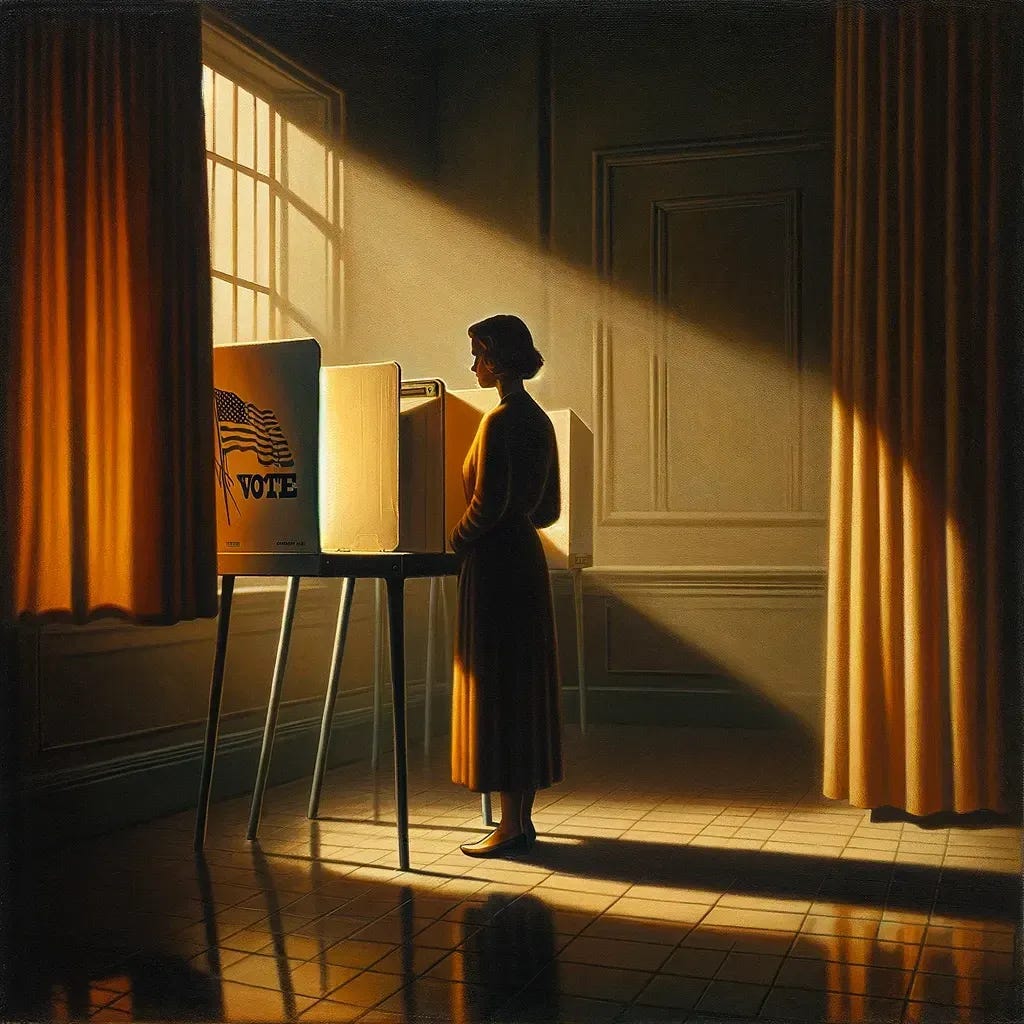
Piqua voters will face an unusual and important Election Day on Tuesday, Nov. 3. Residents will not vote in just one election. They will vote in the regular general election and in a separate special election involving three City Commission recall questions.
It will be confusing. Two check-ins; two times to show identiifcation, two times to sign poll books. Two ballots. Different questions. Different rules. But the most important point is simple: Piqua residents should plan to take part in both elections.
The decisions made on Nov. 3 will affect the future of Piqua’s City Commission and the city’s approach to data-center development. This is a moment when every eligible voter should learn about the issues, make a plan to vote, and stay through both parts of the process.
What The Commission Did
At its Sept. 15 meeting, the Piqua City Commission approved three ordinances that move the recall process forward.
Ordinance O-14-26 concerns the recall of Ward 1 Commissioner and Mayor Jim Vetter. Ordinance O-15-26 concerns the recall of Ward 3 Commissioner Rick Walker. Ordinance O-16-26 concerns the recall of Ward 5 Commissioner and Vice Mayor Frank DeBrosse.
The Commission approved all three ordinances as emergency measures. That means the Commission waived its normal three-reading process so the city could meet the deadlines in the Piqua City Charter.
The city charter requires recall elections to be held between 40 and 60 days after the petitions are formally presented to the City Commission. Since the Nov. 3 general election falls within that time period, the Commission set the recall election date for Nov. 3. The Board of Elections will run the special election on that same day, but it will remain separate from the regular general election.
The commissioners named in the recall measures did not vote on their own recall ordinances. Mayor Vetter abstained from the vote involving Ordinance O-14-26. Commissioner Walker abstained from the vote involving Ordinance O-15-26. Vice Mayor DeBrosse abstained from the vote involving Ordinance O-16-26. The remaining commissioners voted to approve the ordinances and move the recall process to the Board of Elections.
Two Elections, One Day
On Nov. 3, Piqua voters will participate in two different elections. This decision was affirmed by the Miami County Board of Elections at a recent special election reported by the Miami Valley Today. These two elections will happen on the same date, but they are legally separate.
The first ballot will be the regular general-election ballot. It will include the federal, state, and county offices and tax issues that would normally appear in a November election. It is also expected to include a proposed amendment to the Piqua City Charter dealing with data centers and cryptocurrency mining.
After finishing the regular ballot, Piqua voters will need to check in again for the special recall election. They will show identification a second time and receive a separate special-election ballot.
That special ballot will ask voters whether each of the three commissioners should be recalled. It will also include candidates who want to replace each commissioner if voters approve the recall.
This is different from a normal election. Voters will not simply decide whether to remove an officeholder. They will also have an opportunity to choose who should fill the seat if a recall succeeds.
The Miami County Board of Elections has explained that voters cannot receive both ballots at the same time. Voters will first check in for the general election, vote, and submit that ballot. Then they will go to a second check-in table, show identification again, receive the special-election ballot, and vote a second time.
This will take extra time. That is understandable. But it should not stop anyone from participating. Voters should plan ahead, allow more time at their polling place, and make sure they complete both parts of the day.
Why The Recall Is Separate
The special recall election has to be separate because of the rules in the Piqua City Charter.
A recall ballot includes two connected decisions. First, voters decide whether a commissioner should remain in office. Second, voters choose a possible successor. The commissioner facing recall cannot run to replace himself.
Candidates who want to become a successor must file petitions before the election. Under the charter, those petitions are due at least 30 days before the recall election. That short deadline means the Board of Elections cannot simply add the recall questions and successor candidates to the regular general-election ballot, which was already being prepared and sent to some voters.
The Board of Elections will therefore run a separate special election on Nov. 3. This is more work for election officials and may feel unfamiliar to voters, but it allows the city to follow the recall process required by its charter.
The Board has also said that general-election results will be handled first on election night. The special-election results will be counted and reported after the general-election results are complete. That does not mean officials are delaying recall results. It means they are managing two elections at the same time.
Piqua Votes Citywide
One part of this election may surprise some residents. Although Vetter, Walker, and DeBrosse represent specific wards, the recall questions are citywide.
Piqua’s ward system helps make sure different neighborhoods have representation on the City Commission. A person seeking a Ward 1 seat must live in Ward 1. A person seeking a Ward 3 seat must live in Ward 3. A person seeking a Ward 5 seat must live in Ward 5.
However, Piqua Commission candidates run before voters across the entire city. The ward requirement decides where a commissioner must live. It does not limit voting to people who live in that ward.
That means eligible voters throughout Piqua will vote on whether Vetter, Walker, and DeBrosse remain on the Commission. They will also vote for potential successor candidates in each race.
The Data Center Question
The recalls are not the only major Piqua issue expected on the Nov. 3 ballot.
The regular general-election ballot is also expected to include a proposed charter amendment related to data centers and cryptocurrency mining. That proposal grew from the same public debate that brought the recall petitions forward.
Many residents have raised questions about how the city has and is handling the data-center project. The discussion has included concerns about public input, the speed of the approval process, tax arrangements, infrastructure, water and power needs, and the city’s long-term direction.
Still, the data-center charter amendment and the recall elections are separate questions. Voters should consider each one on its own.
A voter may support the data-center amendment and oppose all three recalls. Another voter may oppose the amendment but support one or more recalls. A voter may feel differently about each commissioner. That is the purpose of separate questions and separate races.
The Board of Elections Gives Notice
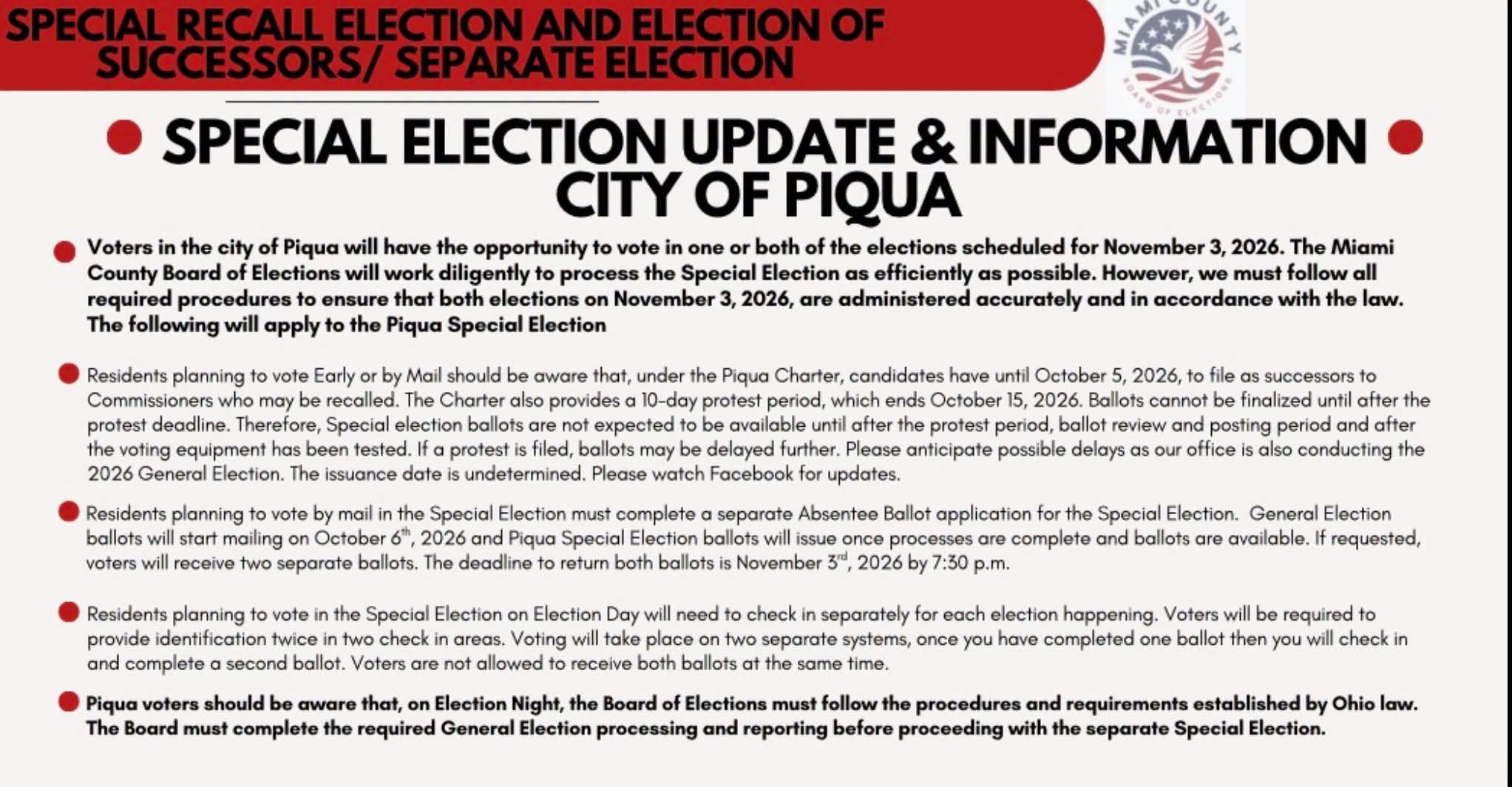
Yesterday, the Board of Elections published information about the Special Election that will be held for the recall. The information from the board stated the following:
Voters in the City of Piqua will have the opportunity to vote in one or both of the elections scheduled for November 3, 2026. The Miami County Board of Elections will work diligently to process the Special Election as efficiently as possible. However, we (the Board) must follow all required procedures to ensure that both elections on November 3, 2026, are administered accurately and in accordance with the law.
The following will apply to the Piqua Special Election
Residents planning to vote Early or by Mail should be aware that, under the Piqua Charter, candidates have until October 5, 2026, to file as successors to Commissioners who may be recalled. The Charter also provides a 10-day protest period, which ends October 15, 2026. Ballots cannot be finalized until after the protest deadline. Therefore, Special election ballots are not expected to be available until after the protest period, ballot review and posting period and after the voting equipment had been tested. If a protest is filed, ballots may be delayed further. Please anticipate possible delays as our office is also conducting the 2026 General Election. The issuance date is undetermined. Please watch Facebook for updates.
Residents planning to vote by mail in the Special Election must complete a separate Asbsentee Ballot application for the Special Election. General Election ballots will start maining on October 6, 2026 and Piqua Special Election ballots will issue once processes are complete and ballots are available. If requested, voters will receive two seperate ballots. The deadline to return both ballots is November 3, 2026 by 7:30 p.m.
Residents planning to vote in the Special Eleciton on Election Day will need to check in seperately for each election happening. Voters will be required to provide identification twice in two check in areas. Voting will take place on two separate systems,, once you have completed one ballot then you will check in and complete a second ballot. Voters are not allowed to receive both ballots at the same time.
Piqua voters should be aware that, on Election Night, the Board of Elections must follow the procedures and requirements established by Ohio law. The Board must complete the required General Election processing and reporting before proceeding with the seperate Special Election.
Make A Plan To Vote
The upcoming elections will ask more of Piqua voters than a normal Election Day. It will require patience, preparation, and attention. But it also gives residents a direct chance to make decisions about leadership and public policy.
Read the ballot language when it becomes available. Learn about the people who file to succeed a recalled commissioner. Review the data-center proposal. Ask questions. Talk with neighbors. Use reliable information.
Then make a plan to vote on Nov. 3. Bring proper identification. Allow extra time. And after completing the General Election ballot, remember to complete the separate Special Election ballot.
The process may be different, but the purpose is the same. Piqua’s future will be shaped by the people who take the time to participate.
Announcing our September Community Survey!
Every other month, this publication takes time to ask our readers how they feel about the happenings in their hometown! What are the challenges? What are the opportunities? Is your hometown headed in the right direction? Our survey is the easiest way for you to express your thoughts. Next month, this publication will report out on the results.
Thanks for your time and your participation! It is greatly appreciated!
This is what it looks like when residents stay informed. If you find value in this work, share it with a neighbor, a colleague, or anyone who cares about this community. Paid subscriptions keep it going — $5 a month.
Civic Capacity runs on one thing: readers who believe local journalism matters. If you want to support this work without a subscription, you can now make a one-time contribution through Buy Me a Coffee — or in my case, Buy Me an Iced Tea. Click the button below. Every contribution goes directly into the work you read here every day.