


Every two months, this publication asks readers the same short set of questions. We want to know how our friends and neighbors feel about home, and whether that feeling is changing.
Our September 2026 survey shows a clear gap. People feel much worse about the country. They feel a little better about Troy.
A quick note on the numbers first. Sixty-nine readers took this survey, and the margin of error is 12%. This is not a scientific poll. It is a look at how our own readers feel. Small changes can be noise, so the focus on the larger swings.
The nation: a new low
In September, just 9% said the nation is on the right track. That is the lowest number in the 20 surveys we have run since July 2023. The share saying wrong direction hit 81%, the highest we have recorded. A year ago, in September 2025, those numbers were 31% and 51%.
That is not a small shift. It is far bigger than the margin of error.
Ohio: slipping
Ohio did not fall as far. 18% said right track, the same as last September. But 61% said wrong direction, up from 46%. Only 21% were unsure, so fewer people are sitting on the fence.
Troy: a better mood
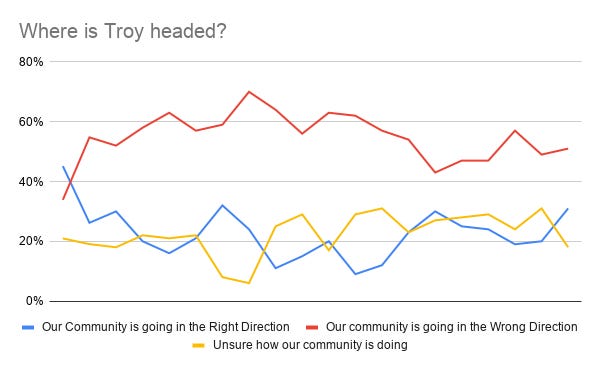
Here is the surprise. 31% said Troy is going in the right direction. That is up from 23% last September and 20% in July. The share saying wrong direction barely moved: 51%, compared with 54% a year ago. The share who were unsure dropped from 31% in July to 18%.
What happened? It looks like some people who were unsure made up their minds, and many decided Troy is on the right path. That is welcome news. But half of our respondents still say wrong direction. And 31% is well below the 45% we saw in July 2023, when we began. Given the margin of error, this is more like a hopeful sign, not a trend.
Looking a year ahead
This publication also asked how confident people are that things will get better in their hometown over the next year. In September, 40% said somewhat confident, the highest in our series. Another 3% said extremely confident. Together that is 43%, up from 32% last September.
The share saying “no change” fell to 22%, the lowest we have seen. A year ago it was 35%. Residents are less willing to assume nothing will happen.
But they are not all hopeful. 24% said somewhat not confident and 11% said not confident at all. That is 35% on the doubtful side, up slightly from 33% last year. Our community is not moving toward one mood. It is splitting into two.
How people feel about home
56% say they love their community, about the same as last year’s 55%. That is a steady, healthy number.
Look at the middle, though. The share who like Troy but do not love it fell from 38% to 32%. And the share who feel no emotional attachment rose from 3% to 7%. These are small numbers, and they could be noise. But they are worth watching. Love for home is holding. The softer middle is where we could lose people.
How well people are paying attention
These were some of the most hopeful statistics that the survey revealed. Awareness rose. 27% said they are extremely aware of what is happening in the community, and 46% said very aware. That is 73% at the top end, up from 58% last September. No one said they were not aware at all.
Keep in mind who answers this survey. These are people who largely read this newsletter, so of course they pay attention. Still, an engaged audience is what this publication is for.
What it means
The mood in Troy is not simply following the mood in Washington or Columbus. Our neighbors seem to separate what they see in their own town from what they see on the news. That is good news for city hall.
But it is not a blank check. Half of our respondents still say Troy is headed the wrong way. People who are hopeful and people who are doubtful are watching the same decisions, and both groups want to see results.
This publication will ask again in November. If you have not taken the survey yet, please join us next time. More voices make the numbers better, and a better picture helps all of us.
This is what it looks like when residents stay informed. If you find value in this work, share it with a neighbor, a colleague, or anyone who cares about this community. Paid subscriptions keep it going — $5 a month.
Civic Capacity runs on one thing: readers who believe local journalism matters. If you want to support this work without a subscription, you can now make a one-time contribution through Buy Me a Coffee — or in my case, Buy Me an Iced Tea. Click the button below. Every contribution goes directly into the work you read here every day.