Our Community Survey: Troy Speaks Out
Vol. IV, No. 11 - Our largest survey for Troy shows the same troubling pattern
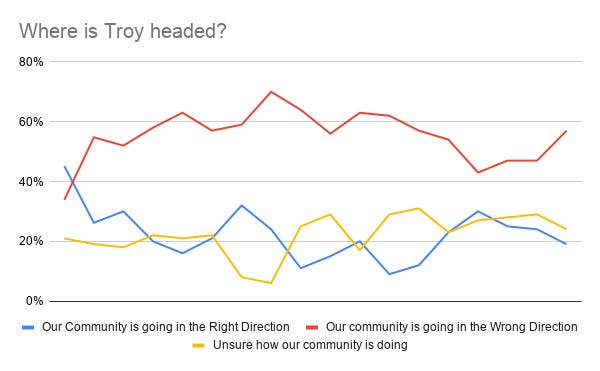
Last month, 107 Troy-area residents answered the Civic Capacity Community Survey — the largest single sample in three years of polling. And the story the data tells us is something local leaders should pay attention to. Fifty-seven percent believe this community is headed in the wrong direction. Only 19% say we’re on the right track.
That’s not a polling blip. That’s a pattern.
Since this publication launched this survey in July 2023, the community “wrong direction” number has been above 40% in every single wave. Every one. Through two election cycles, economic announcements, new development projects, and municipal budget cycles, a consistent majority of engaged Miami County residents have looked at Troy and said: we’re not going the right way.
That is worth sitting with before we explain it away.
A Nation Recovering, A Community Still Stuck
Here’s where the story gets complicated. On the national level, pessimism has eased. In May 2026, 52% of our respondents say the nation is going in the wrong direction — still a majority, but the lowest national wrong-track reading in our dataset. Twenty-eight percent say the country is on the right track, up from just 11% in the summer of 2023.
At the state level, Ohio is near its worst reading. Only 19% say the state is headed in the right direction — a number that has been sinking since peaking at 41% in May 2025. Fifty-three percent say Ohio is on the wrong track.
So residents feel cautiously better about the country, deeply skeptical about Ohio, and persistently pessimistic about their own hometown. The further the lens zooms in, the darker the view. That is a troubling inversion. You would expect people to feel most optimistic about the place they know best, the community where they volunteer, vote, and raise their families. Instead, the closer to home we ask, the worse the numbers get.
This tells us something specific: this isn’t general political frustration bleeding into local sentiment. Residents aren’t just cranky about national politics and projecting it downward. They are arriving at a separate, independent judgment about Troy — and that judgment has been consistently negative for three years running.
The Paradox That Demands an Explanation
Now here is the number that should genuinely puzzle anyone paying attention: 93% of May 2026 respondents say they love or like this community. Not a single person said they loathe it.
Read that again alongside the other number. Fifty-seven percent think we’re going in the wrong direction. Ninety-three percent love or like living here.
That is not a contradiction you can dismiss. These are not disengaged, cynical outsiders lobbing complaints. These are people with deep roots and genuine affection for Troy. They are not threatening to leave. They are not angry at their neighbors. They are frustrated with something else — with decisions being made, with processes they can’t access, with outcomes they didn’t choose and weren’t asked about.
Place attachment and institutional distrust can coexist. In fact, they almost always do when residents feel genuinely out of the loop on the decisions that shape their daily lives. That is precisely the gap this publication was built to close.
The Optimism Gap
When we ask whether things will get better in the next year, the numbers are only marginally encouraging. In May 2026, 27% expressed some degree of confidence that their hometown will improve. Thirty-four percent said they were not confident. Thirty-nine percent expect no change at all.
That “no change” bloc is the most telling number in this section. It has hovered near 40% for most of the past three years. These are not pessimists. They are residents who have stopped expecting anything different. Learned resignation is harder to reverse than active frustration, and it is quietly becoming the dominant emotional posture toward local government in this community.
What Three Years of Data Actually Tell Us
This publication has now run this survey 18 times. Last month’s sample — 107 participants with a margin of error of just 9% — is the most statistically reliable that has been collected since this effort began. And what that data shows, in aggregate, is not complicated.
Residents love Troy. They do not trust its direction. They are not optimistic that the direction will change. And their awareness of local civic affairs, while still relatively high, has been declining over the past year.
That last point is a challenge this publication takes personally. A well-informed community makes better decisions. It elects better leaders, asks harder questions, and holds institutions to a higher standard. When awareness slips, everything downstream suffers.
The data is not an indictment of any one administration or council. It is a three-year portrait of a community that feels it is not being heard, not being leveled with, and not being brought to the table.
That is the problem Civic Capacity was built to address. And the fact that the problem persists — consistently, stubbornly, across 18 survey waves — means the work is nowhere near done.
This is what it looks like when residents stay informed. If you find value in this work, share it with a neighbor, a colleague, or anyone who cares about this community. Paid subscriptions keep it going — $5 a month.
This Month, we are doing something different! We are partnering with the Troy-Miami County Public Library by using this platform to raise funds for the Dolly Partin Imagination Library locally here in Miami County! Through the Dolly Partin Imagination Library, children from birth to Kindergarten, can get a book delivered every month to their home at no cost.
And while Dolly is a huge help, she picks out the stories and she works with the publishers, there is still a local cost to the program. Your donations through our “Buy Me A Coffee Page” will help get these youngsters on the right track to a life-long love of reading!


