Piqua City Commission Nixes Loans to Purhcase Properties
Vol. III. No. 293., Two loans to Communinty Improvement Corporation die for lack of second
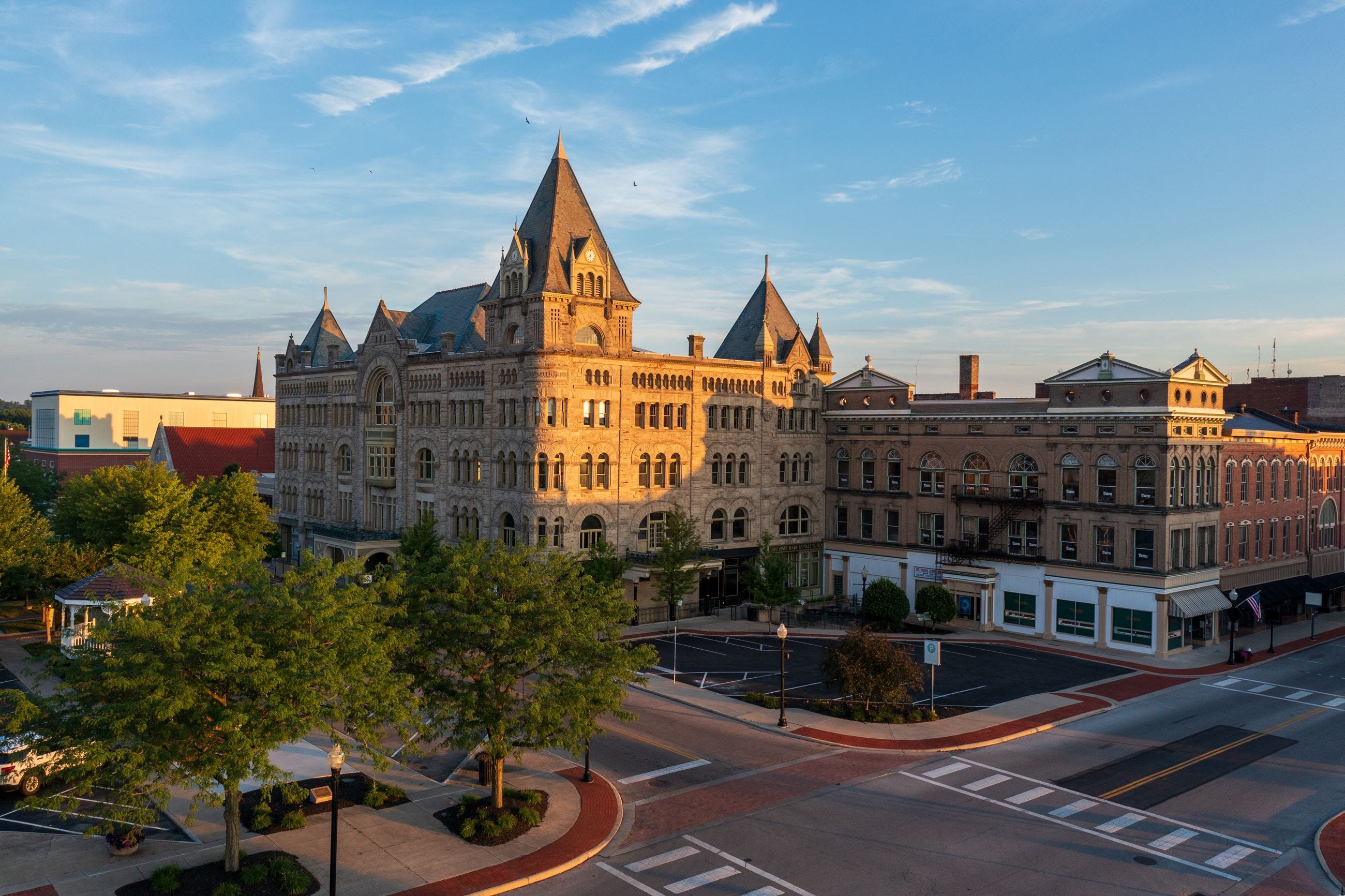
The City of Piqua recently declined to move forward on two resolutions that would have loaned public money to the Piqua Improvement Corporation to purchase two downtown parcels, both in close proximity to Lock Nine Park. The Commission’s hesitation may have been the right call. Here’s why residents should be paying close attention.
Two Resolutions, Two Unanswered Questions
The two failed resolutions would have directed public loan dollars to the Piqua Improvement Corporation to purchase:
The Zollinger Building — a property the Piqua Improvement Corporation previously received from the City, sold to a developer, and that developer now wants to unload. Another developer — the developer behind the Town and Country Building — has reportedly been identified as a potential buyer.
The Edison Building on East Water Street — owned by a private individual who completed exterior renovations but decided not to proceed with interior work, and who is now looking to sell.
In both cases, the same foundational question applies: Why does the Piqua Improvement Corporation need to be the middleman?
In the case of the Zollinger Building, the current owner and the interested buyer are both private parties. Why can’t that transaction happen directly between them? City staff indicated they are “not in the real estate business” — but the Piqua Improvement Corporation absolutely is. Under Ohio Revised Code 1732.01(a)(3), community improvement corporations are expressly authorized to purchase, hold, manage, lease, and dispose of real and personal property. That is their defined function.
City staff stated that the Piqua Improvement Corporation steps in when the private market fails. That is the right standard. The problem is that there is no evidence the private market was ever given the opportunity to succeed here. How long had the Zollinger Building been listed or available to private buyers?Has the Edison Building owner attempted to sell to a private buyer before approaching the Piqua Improvement Corporation?
These are not hostile questions. They are the minimum due diligence residents should expect before public dollars enter any transaction.
The “First Dollar” Problem
During the City Commission meeting, City Commissioner Frank DeBrosse and city staff acknowledged that the City sometimes has to put forward the first dollar to attract private investment. That logic has a place in economic development — but it comes with serious conditions.
The argument that public dollars should be the last dollar in, not the first, is not ideological. It is sound fiscal stewardship. Public money is tax revenue collected from residents and businesses. Risk must be minimized. The private market should exhaust its options before public funds are used to facilitate a transaction that two private parties could conceivably complete on their own.
The City Commission’s decision not to move forward on both resolutions may signal some healthy skepticism. But these resolutions may return. Residents need to remain engaged.
The Transparency Problem
Underneath both resolutions is a larger issue: accountability and transparency within the Piqua Improvement Corporation itself.
Did the Piqua Improvement Corporation’s board formally approve bringing these loan requests to the City Commission — or did city staff bring them forward independently? The Piqua Improvement Corporation does not appear to have held a public meeting in 2026 — at least none appear in the City’s Agendas and Meetings portal.
This matters. The Piqua Improvement Corporation is the same entity that signed the Non-Disclosure Agreement related to the recent data center project — an agreement that shielded information from the public. Residents are still waiting on clear answers from that episode. A community improvement corporation that operates without regularly scheduled public meetings, that facilitates transactions under NDAs, and whose internal decision-making process is unclear, should not be the vehicle for deploying public loan dollars — at least not without significant reform to how it operates and communicates with the public.
The Pump Has Been Primed — Now Show the Results
Throughout the discussion that occurred at the City Commission meeting, there was a legitimate argument that sometimes government must prime the pump. The argument that the purchase of these two properties would help prime said pump.
What was noticably absent from the discussion was the multi-million park within a stone’s throw of those properties. Lock Nine Park is the primed pump created in concrete and green space. The City has committed roughly $4 million to transform that corner and signal to the private market that Piqua is serious about downtown investment. New businesses have followed — Crooked Handle Brewing is one example.
But priming the pump only justifies the next public dollar if someone is measuring what the first dollars actually produced. That accounting has never been presented publicly in any clear, measurable way.
What is the actual return on that $4 million?
How much have property values increased in the surrounding area?
How much new income tax revenue has been collected from businesses that located there as a direct result of the park investment?
What was the baseline before the investment, and what is the benchmark today?
If the City intends to continue using public dollars to prime development near Lock Nine — whether through direct investment, loans to the Piqua Improvement Corporation, or property acquisitions — residents deserve to know two things before that next dollar is committed: how much more is needed, and exactly how it will be used. Anecdotes and ribbon cuttings are not an answer. Numbers are.
What Residents Should Ask
Before R-44-2026 and R-45-2026 come back before the Commission in any form, Piqua residents should be pressing for answers to these questions:
What is the documented return — in property values and income tax revenue — on the $4 million Lock Nine Park investment?
Were the Zollinger and Edison buildings ever actively marketed to private buyers, and for how long?
Why can’t the Zollinger Building transaction occur directly between the two identified private parties?
Did the Piqua Improvement Corporation board formally vote to bring these requests to the City Commission?
When did the Piqua Improvement Corporation last meet publicly, and where are those minutes?
Under what conditions would the City treat public dollars as a last resort rather than a first option?
Of course, any smart observer of the Piqua City Commission knows that these questions are more than likely not be answered. If there is one behaviour that the Commission has become extremely adept at, it’s sitting up there quiet and stone faced as residents ask questions during public comment time.
Occassionally, when public comment is closed a Commissioner may repeat the question to City Staff, but these instances are few and far between and those difficult questions that really need answered are conveniently glossed over for the city administration to answer.
Public investment in economic development can be appropriate. But appropriate means accountable, transparent, and deployed only when necessary. The pump has already been primed. Piqua residents have earned the right to see what it produced — and to demand a clear plan before anyone asks them to pay for more.
Announcing our March Community Survey!
Every other month, this publication takes time to ask our readers how they feel about the happenings in their hometown! What are the challenges? What are the opportunities? Is your hometown headed in the right direction? Our survey is the easiest way for you to express your thoughts. Next month, this publication will report out on the results.
Thanks for your time and your participation! It is greatly appreciated!
This is what it looks like when residents stay informed. If you find value in this work, share it with a neighbor, a colleague, or anyone who cares about this community. Paid subscriptions keep it going — $5 a month.
Civic Capacity runs on one thing: readers who believe local journalism matters. If you want to support this work without a subscription, you can now make a one-time contribution through Buy Me a Coffee — or in my case, Buy Me an Iced Tea. Click the button below. Every contribution goes directly into the work you read here every day.


