


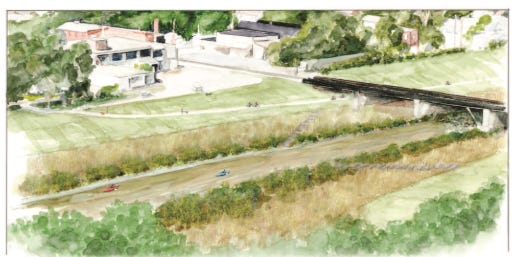
At Monday night’s Safety and Health Committee meeting, city staff clarified that Troy is not proposing to build a $2.7 million park.
That is materially different from what residents could reasonably conclude from the written transmittal memorandum provided to Safety and Health Committee before their meeting on Monday evening.
The transmittal memo said the city had applied to the U.S. Department of Housing and Urban Development for $2,700,689.28, had received a partial $1 million award, and would use the grant to support the Great Miami River Recreation Connectivity Project, including construction of a River Plaza watercraft launch connected to a future downtown river recreation trail.
The written memo did not explain that the original $2.7 million request included a broader collection of possible purposes. During the committee discussion, staff said the request was submitted some time ago and included elements connected to the low-head-dam project, oxbow redevelopment, a future trail extension, the former Crawford Street concept, and improvements in the area that may become the River Plaza.
Staff said that other funding sources have now been secured for elements of the broader dam-removal work and that the $1 million HUD award would be used for the River Plaza component. The project, according to staff, is not intended to be a conventional neighborhood park or part of the Crawford Street proposal, which remains on hold.
That clarification is useful. It also came during a roughly half-hour committee discussion, rather than in the written record that residents had available before Council acted.
It Is Still a Public Recreation Facility
The city may not regard the River Plaza as a “park park.” That label, however, does not resolve the actual question.
The city has described a public facility that would include green space, pavement, a canoe, kayak, and watercraft launch, docking, possible accessible features, and a connection to a future river recreation trail. During the meeting, Council members discussed adding picnic tables, places for trail users to stop, and an ADA-accessible launch similar to the facility at Treasure Island.
That is not a conventional neighborhood park. It is still a new public recreation facility.
Its absence from the recently adopted Master Recreation and Parks Plan remains relevant. The plan identified competing capital needs, including Duke Park, the Joe Reardon Skatepark, Miami Shores Golf Course, Troy Aquatic Park, and the Troy Senior Citizens Center. It also discussed uneven access to recreation in different parts of the city and called for deliberate decisions about the future use, reuse, and possible disposal of underutilized park assets.
Troy can pursue a recreation facility outside the master plan. But when it does, there should be some explanation why that facility is a priority, what need it serves, how it ranks against the plan’s identified needs, and what the city expects to spend beyond the federal award.
Construction Funds Before a Plan
The $1 million award is a reimbursable construction grant. It is not a planning grant.
During the committee meeting, Councilmember Susan Westfall asked whether the federal money was intended for planning. Staff answered that it was not. The $1 million would be the construction budget. Westfall then observed that the city would need to come up with the money to plan the project, and staff agreed, saying the city could fund planning itself or seek other grants.
That right there might be the heart of the issue.
Troy has secured $1 million for construction of a River Plaza whose final location has not been publicly established, whose amenities have not been fully defined, whose design has not been completed, whose engineering has not been funded, and whose construction timetable has not been presented.
The city says it expects to return to Council in 2027 for design and engineering. That work would determine what the site can accommodate, how the facility might be accessed, how accessibility requirements could be met, what approvals may be needed, and what the facility and possible future trail extension could cost.
The city has, in effect, secured money to build something before it has completed the work necessary to say precisely what that something will be.
Planning by Anecdote?
The committee discussion also provided little evidence of a formal needs assessment for the new launch facility.
Staff said the existing watercraft launches at Treasure Island and Broadford Bridge are in high demand and that city staff had observed use exceeding available parking and space. It also said this understanding was based in part on feedback from U.S. Fish and Wildlife Service staff.
But staff described that evidence as anecdotal. No user counts, parking-utilization data, launch-capacity study, wait-time data, survey results, or comparative analysis of existing facilities was presented.
Other speakers supplied competing anecdotal observations. Some said the Broadford Bridge area can be busy on favorable days but that Treasure Island often appears underused. One speaker questioned whether it would make more sense to improve the existing launch locations rather than create a third facility nearby.
Anecdotes can identify a question worth studying. They are not a substitute for a documented public need when a community is moving toward a new capital facility.
The Next Decision Matters
The city is correct that accepting a reimbursable grant does not automatically approve a final design or commit the city to a completed River Plaza. Council will still need to appropriate planning funds, approve design and engineering work, consider construction documents, and decide whether to proceed.
But accepting a construction grant is not consequence-free. It establishes a direction, creates expectations, initiates administrative work, and makes later spending decisions more likely. Once the city has accepted $1 million intended for a particular public facility, the next pressure is to spend city money—or find still more grant money—to create the plans necessary to use it.
That is why the conversation should not end with, “The city is not building a $2.7 million park.”
The relevant question is whether Troy has adequately planned for a new $1 million public recreation facility before agreeing to accept the construction money. The city still needs to show the public where the facility will be, what it will include, what it will cost to design, how it will work with the levee and river conditions, whether existing facilities have been fully evaluated, what future maintenance will require, and how the project ranks against other recreation and capital priorities.
Announcing our September Community Survey!
Every other month, this publication takes time to ask our readers how they feel about the happenings in their hometown! What are the challenges? What are the opportunities? Is your hometown headed in the right direction? Our survey is the easiest way for you to express your thoughts. Next month, this publication will report out on the results.
Thanks for your time and your participation! It is greatly appreciated!
This is what it looks like when residents stay informed. If you find value in this work, share it with a neighbor, a colleague, or anyone who cares about this community. Paid subscriptions keep it going — $5 a month.
Civic Capacity runs on one thing: readers who believe local journalism matters. If you want to support this work without a subscription, you can now make a one-time contribution through Buy Me a Coffee — or in my case, Buy Me an Iced Tea. Click the button below. Every contribution goes directly into the work you read here every day.
Is it just me, or do we already have an entire park with that purpose? (Treasure Island) Maybe, instead of building an entire new facility, we use and maintain the one that is already there and try to make it usable again.
We took a trip down the river from Piqua to Troy on the 4th of July, the river in Troy spread out and got really shallow. But the boat docks were literally inaccessible. It was basically 6-8" of mud with 3" of water. You had to get out and walk up the bank from the actual river's edge. Going into the area by the Boathouse was a mistake! I'm not a hydrologist, so I certainly don't have the answers, but it seems like they spent a bunch of money to create the park and now barely use it.