

The Tradeoffs of West Main Street
Vol. IV, No. 35 - A $4 Million Project Has Few Winners

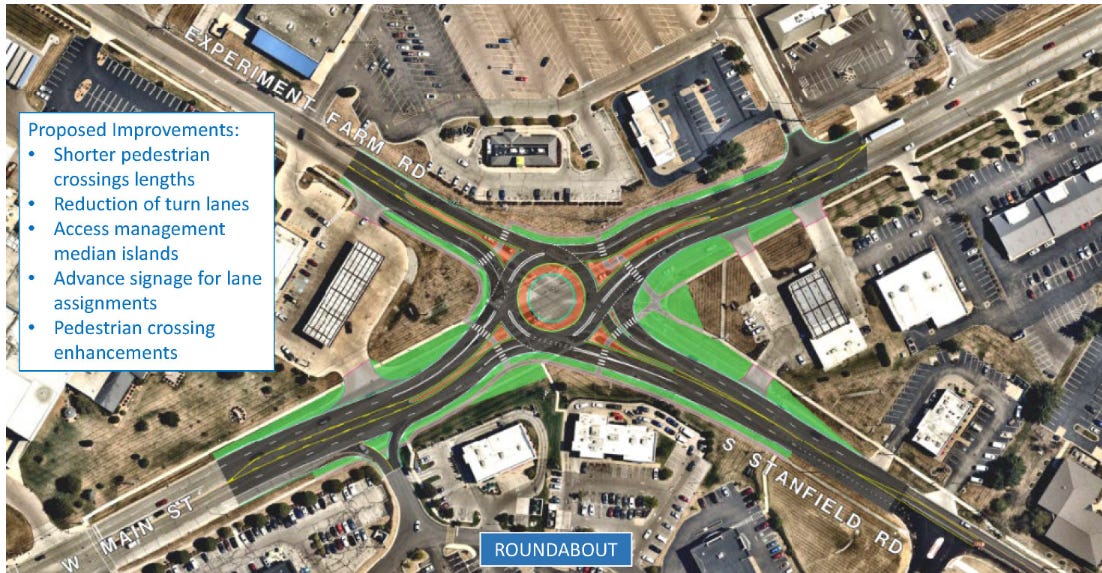
On paper, the choice at West Main, Stanfield and Experiment Farm looks simple. The consultants tell us the roundabout and the upgraded signal cost about the same to build – roughly $4.3 million either way, with federal money picking up a big share and TIF dollars covering the rest. If the money is lined up and the drawings look pretty, why not build the “better” intersection?
Because the deeper question isn’t whether we can afford the concrete. It’s what, exactly, we’re buying – and who pays the real cost when we lock that choice in.
The presentation at Wednesday night’s City Council Committee of the Whole meeting hammered home the safety and operations case for a multi‑lane roundabout. Rear‑end crashes at this signal are off the charts compared to the rest of Troy. Injury crashes show up every year. A roundabout almost certainly trades a portion of those higher‑severity wrecks for low‑speed fender‑benders. On the side streets, especially northbound Stanfield, the modeled delay drops dramatically under the roundabout option – down into the mid‑20‑second range from today’s 67 seconds.
Those benefits are real. They just come at a pretty expensive price tag — and it’s more than just money.
First, there’s disruption. Both alternatives will tear up the intersection and make a mess for businesses and drivers during construction. But a full roundabout rebuild is simply more complex geometry than a widened and re‑timed signal. It means more work in the middle of the roadway, more tight staging in and out of curb cuts, and a higher risk that schedules slip in a corridor that still has scar tissue from West Main’s last big construction cycle. It means creating a maintenance of traffic plan during construction that will be an absolute nightmare to navigate.
That disruption cost doesn’t show up in the neat bar chart comparing signal heads and landscaping. It’s paid by workers trying to get to Honda or F&P America, by folks going grocery shopping, and by the dozens of retail businesses that depend on a not‑totally‑chaotic West Main to stay afloat.
Second, there’s fit. West Main from I‑75 through Meijer and Lowe’s is already a patchwork of projects, access points and signals. It is not a clean test lab for textbook geometry. Today, that corridor operates on one simple logic: green‑red‑yellow, over and over. It’s not great – but everyone understands it.
A modestly widened and re‑timed signal at Stanfield and Experiment Farm keeps that operating logic consistent. You still have signals at I‑75, Troy Towne, Marybill and King’s Chapel. You still manage queues and timing across an entire corridor that lives or dies by how the signals talk to each other.
Dropping a multi‑lane roundabout into the middle of that signalized patchwork imports a completely different operating system. Instead of one set of rules from the interstate to the west side neighborhoods, drivers get a sudden, complex “yield, pick a lane, watch three sets of conflict points” moment right where the corridor is already the most stressful. And as several residents pointed out, the Dorset/McKaig Roundabout experience shows that the learning curve and confusion are not minor details for this community.
Third, and maybe most important, there’s permanence. Signals are annoying, but they’re flexible. If growth happens differently than the traffic model expects, staff can re‑time phases, tweak turn lanes, adjust detection, and upgrade controllers. None of that is glamorous, but it is the work of managing a living corridor.
A roundabout, especially one this large and complex, is a bet that this geometry is the right answer for the next twenty‑plus years. The consultant’s own numbers assume a 20‑year service life. Once it’s poured and landscaped, it becomes very hard – financially and politically – to admit it might not be the right shape for whatever West Main becomes after the next wave of development and code changes.
All of this is happening at an intersection that the city’s own data say is not failing. The current configuration earns a D level of service, which, in the world of urban traffic engineering, is the low end of “acceptable,” not a failing grade. The improved signal alternative pulls it into the C range. The roundabout keeps it around a D on paper, even as it moves traffic differently. We are not rescuing a collapsing F intersection. We are nudging a functioning, if frustrating, one.
In retrospect, we may be learning the wrong lesson about when to build roundabouts in Troy. The best time to build one is when you don’t need it – when a corridor is being designed from scratch, when right‑of‑way is flexible, and when you aren’t trying to shoehorn new geometry into a signalized system that basically works. Trying to retrofit a functioning but frustrating signalized intersection into a large multi‑lane roundabout, in the middle of a busy commercial strip, could easily become a solution that isn’t truly addressing the problems residents actually experience day to day.
So we’re left with tradeoffs.
We can convert more serious crashes into possibly more fender‑benders. We can rebalance delay between West Main and the side streets. We can trade higher long‑term signal maintenance costs for the up‑front permanence of a roundabout. Those are value questions, not engineering mandates.
For a community still wrestling with an admittedly undersized roundabout out Dorset and McKaig, and a business community already fatigued by construction on West Main, and trying to hold a patchwork corridor together, it is reasonable to decide that a well‑designed, properly maintained signal is the better course of action at this intersection than a multi‑lane roundabout that promises more than it can realistically deliver.
If council chooses the roundabout, they should say that out loud: they are choosing lower‑severity crashes and side‑street relief over familiarity and corridor consistency, and they should own that choice. If they choose the signal, they owe residents an equal commitment – not to do nothing, but to finally do the unglamorous work of retiming, maintaining and managing West Main as a system, instead of chasing a magic piece of geometry every few years.
These aren’t easy decisions.
This is what it looks like when residents stay informed. If you find value in this work, share it with a neighbor, a colleague, or anyone who cares about this community. Paid subscriptions keep it going — $5 a month.
This Month, we are doing something different! We are partnering with the Troy-Miami County Public Library by using this platform to raise funds for the Dolly Partin Imagination Library locally here in Miami County! Through the Dolly Partin Imagination Library, children from birth to Kindergarten, can get a book delivered every month to their home at no cost.
And while Dolly is a huge help, she picks out the stories and she works with the publishers, there is still a local cost to the program. Your donations through our “Buy Me A Coffee Page” will help get these youngsters on the right track to a life-long love of reading!
Thanks to John And Kim, Rachelle. Loraine S., Loraine W., and a special anonymous donor, for your recent donations to this effort. So far this month — 71 books have been purchased! Thank you!