Troy's $860,000 Question: What Exactly Did The City Tell Washington?
Vol. IV, No. 3 - The City is inline to receive a highly competitive federal grant from the Department of Transporation for West Main Street
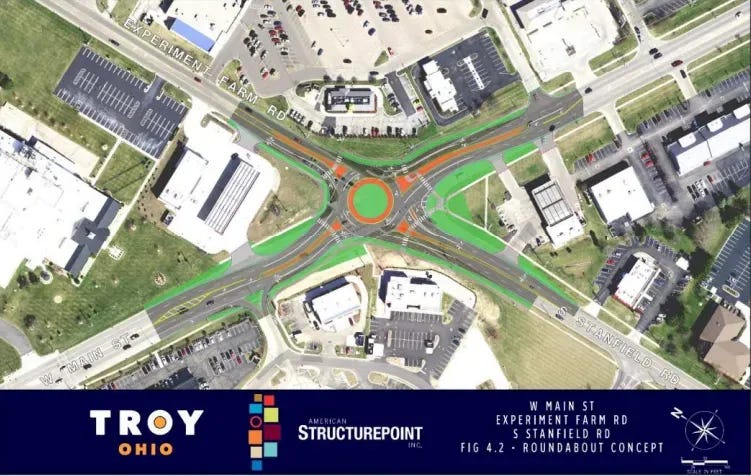
On Tuesday, May 26th, the City of Troy’s Streets and Sidewalks Committee will be asked to recommend that City Council enter into an $860,000 grant agreement with the U.S. Department of Transportation. The money comes from the Rural and Tribal Assistance (RTA) Pilot Program — a highly competitive federal grant program administered through the Build America Bureau — and is earmarked for improvements to the West Main Street/Experiment Farm Road/Stanfield Road intersection. Unlike most items that show up on committee agendas, there was absolutely no transmittal memo from the City Administration on this item in the committee agenda announcement: just a notation that the transmittal will be made to the committee before Tuesday’s meeting.
On the surface, this sounds like good news. Federal dollars coming to Troy for a notoriously busy intersection? Hard to argue with that. But before anyone pops the champagne, there’s a question that deserves a straight answer: what exactly did the City of Troy tell the federal government to get this grant?
The Grant Does the Talking
According to the U.S. Department of Transportation, this funding “will be used to conduct final design phase activities for improvements to an intersection that connects three key roadways and serves as a vital link to the city’s transportation network.”
Final design phase. Those three words matter.
This isn’t a study. This isn’t a feasibility analysis. The RTA program funds pre-construction work — planning, engineering, environmental review, financing analysis. And if Troy is already in the final design, then the conceptual direction for this intersection was decided well before Tuesday’s committee meeting, it could have easily been decided last Summer when the application for these dollars was submitted. The question isn’t whether to study the intersection. The question is: what does final design mean to Washington?
The RTA program received 799 applications from 49 states requesting more than $789 million in total funding. Only 49 projects were awarded — roughly 6% of applicants. Logic dictates that the program projects that rise to the top are typically ones that are well-developed and ready to move. Troy’s application was competitive enough to win. That may tell you something about how far along this design already was.
And perhaps, the city was able to secure this grant without knowing whether it wants a roundabout or enhances signaling at the intersection. It’s certainly possible, but it simply underscores the fact that the City Administration needs to spend more effort and energy in communicating this project to the public. Funds for this project were requested in September, the public announcement of these funds were made on April 6th and still there has been no public mention from City Hall on these funds and what they are expected to provide for the community.
A Familiar Pattern?
If this feels familiar, it should.
Nearly two years ago, this publication documented how the City Administration has a habit of applying for grants, securing the funds, and then presenting City Council with a fait accompli — essentially daring elected officials to walk away from money that’s already on the table. We’ve seen it with the South Shore Recreational Trail along the Great Miami River. We’ve seen it with the Crawford Street shared-use path. Projects which have more questions are put in grant requests for funding, whether they enjoy broad public support or not.
The script is consistent: the community raises concerns early, the administration says it’s too soon to discuss the details, then the details arrive pre-packaged with a price tag and a grant request — and in this case, a federal seal of approval with $860,000 attached.
In each of those cases, council members and residents who asked reasonable questions were told that when discussing funding, it just wasn’t the right time or place to weigh in. That the funding requests were just a formality. That the real conversation would come later.
Well. Here we are again.
What The Committee Should Be Asking Tuesday
The roundabout concept for this intersection has come up repeatedly in recent council meetings — in public comment and in council discussion — without any definitive answer on whether it’s the City of Troy or the Ohio Department of Transportation driving the design. The City Administration has promised clarity. But now entering into an $860,000 federal grant agreement before that clarity arrives feels backwards.
Before the Streets and Sidewalks Committee recommends anything, council members should be pressing for clear answers to the following:
Was their a specific design concept was submitted to the U.S. DOT in the grant application?
Was a roundabout explicitly or implicitly represented as the preferred design alternative?
What public engagement will be occurring as this project moves forward?
What is the projected total project costs beyond this $860,000 in design funding for all alternatives studied?
What agency is pushing for a roundabout, the City Administration or the Ohio Department of Transportation?
These aren’t obstructionist questions. They are the basic due diligence questions that any elected body should ask before binding the city to a federal agreement.
The Bigger Issue
Troy has 26,000 residents. The West Main Street corridor is one of the busiest and most commercially significant stretches in the city. A decision about the long-term design of that intersection — roundabout, signalized redesign, or something else — deserves a full public conversation before the final design agreed upon, engineering contracts are signed and the concrete is poured. The City has indicated a public meeting will be held in early July on this topic.
The federal government isn’t the villain here. The RTA program is a legitimate tool built to help smaller communities fund infrastructure they couldn’t otherwise afford to engineer. But a grant agreement is still an agreement, and agreements have momentum. Once signed, the design direction it funds becomes the path of least resistance for every decision that follows — the construction bid, the financing plan, the ribbon cutting.
City Council was elected to make decisions, not ratify them after the fact. Tuesday’s committee meeting is the moment to ask the hard questions — not after the ink is dry, not after the engineering firm is hired, and certainly not after a roundabout is half-built on West Main Street. If the City Administration has nothing to hide about what it said to Washington, proving that should be easy.
Announcing our May Community Survey!
Every other month, this publication takes time to ask our readers how they feel about the happenings in their hometown! What are the challenges? What are the opportunities? Is your hometown headed in the right direction? Our survey is the easiest way for you to express your thoughts. Next month, this publication will report out on the results.
Thanks for your time and your participation! It is greatly appreciated!
This is what it looks like when residents stay informed. If you find value in this work, share it with a neighbor, a colleague, or anyone who cares about this community. Paid subscriptions keep it going — $5 a month.
Civic Capacity runs on one thing: readers who believe local journalism matters. If you want to support this work without a subscription, you can now make a one-time contribution through Buy Me a Coffee — or in my case, Buy Me an Iced Tea. Click the button below. Every contribution goes directly into the work you read here every day.


