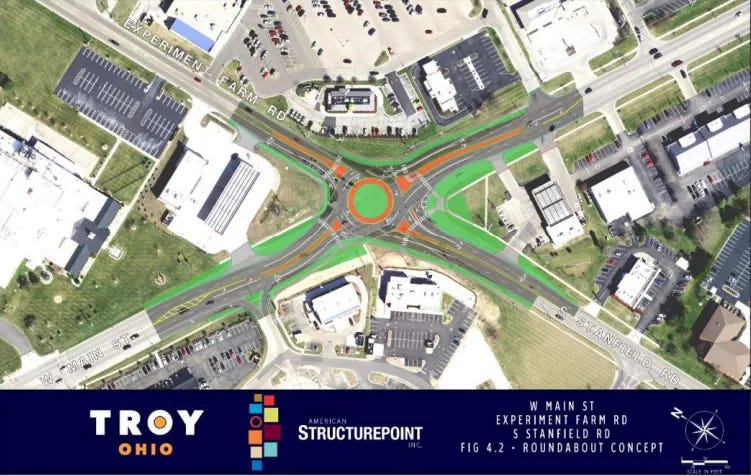
Troy's Main Street Roundabout Just Got More Complicated
Vol. III, No. 362 - It's Not Clear Who Is Calling the Shots - ODOT or the City?
The $120,000 study still hasn’t been released. The cost more than likely keeps climbing. And as of right now, nobody at City Hall can tell you with absolute certainty who actually gets to make the final call on a roundabout at West Main Street and Experiment Farm Road.
That is where things stand after lMonday night’s Troy City Council meeting, where one council member broke from the prevailing narrative and suggested this project may not be as ODOT-driven as residents have been led to believe.
It is worth stepping back to remember how we got here.
A Timeline That Keeps Shifting
In September 2023, Troy applied for federal Surface Transportation Program funding through the Miami Valley Regional Planning Commission to improve the West Main and Experiment Farm intersection — a project estimated at the time of $4.2 million. The city believed at the time that ODOT had already approved a roundabout as the preferred solution. That turned out not to be the case.
In late 2024/early 2025, ODOT required an entirely new feasibility study using updated methodology under their OATS manual, adopted in 2021. Council approved $120,000 for that study in January 2025. The study was due by March 31, 2025, then extended to March 31, 2026. This publication noted the silence when that second deadline passed without a public announcement.
At Monday’s council meeting, the city administration indicated the study has been submitted to ODOT for their review and acceptance. That is not the same as the study being complete or publicly released. As of this writing, residents have not seen the findings. The city administration also mentioned a public meeting as a next step — but no date has been confirmed.
The federal grant of $2.5 million remains in place. The cost estimate, last reported at $6 to $7 million in January 2025, has not been publicly updated and has more than likely increased; infrastructure costs do not hold still.
The Question Nobody Can Answer
Here is what made Monday night’s discussion notable. After more than two years of public conversation, the city adminstration still cannot answer a fundamental question: does Troy have the authority to reject a roundabout recommendation, or does ODOT have final say?
The administration said they are asking ODOT District 7 directly and expect a response within a week or two. That clarification is way overdue. What is harder to explain is why it wasn’t resolved before the $120,000 study was authorized, or before the city accepted $2.5 million in federal funding with all the conditions attached to it.
In the past, the city administration has acknowledged that forfeiting the grant would cost the city not only the $2.579 million, but penalty points on future funding applications as well. That financial leverage is real — and it is exactly why the question of decision-making authority matters so much.
If ODOT Wants This, ODOT Should Pay for It
Here is a question that hasn’t been asked loudly enough: if the Ohio Department of Transportation is the one requiring the study, setting the methodology, reviewing the findings, and pushing the recommendation for a roundabout — why are Troy taxpayers being asked to cover the majority of the bill?
The federal grant covers $2.5 million of an estimated $6 to $7 million project. That leaves somewhere between $3.5 and $4.5 million on the local tab — and that estimate is more than a year old. If ODOT’s own process, their own engineers, and their own standards are driving this project forward, then it’s not out of the question to say that ODOT should be funding it fully. Asking a mid-sized Ohio city to absorb millions in costs for a project it may not have full authority to reject, and honestly, isn’t even popular with the community, is not a reasonable arrangement.
Severt’s Dissent
Council member Todd Severt stated that he has spoken directly with people at ODOT and received a starkly different read than what the City adminstration put foward. His characterization — that higher-ups at ODOT view this as a city-driven initiative, not an ODOT mandate — directly contradicts the framing that has guided most of the public discussion to date.
Both cannot be true. If Mr. Severt is right, residents have been operating under a false premise. If the city administration’s framing is accurate, Mr. Severt spoke with someone who doesn’t represent ODOT’s institutional position. Either way, residents deserve clarity before any public meeting takes place.
What Residents Should Demand Now
Three things should happen before this project moves any further. ODOT’s answer on final decision-making authority should be disclosed publicly — not buried in a future council agenda. An updated cost estimate should be released. And when a public meeting is eventually scheduled, residents should know well in advance that it is a genuine input opportunity, not a presentation designed to ratify a decision already made elsewhere.
This intersection has been studied two decades and American Structurepoint’s prelminiary study put foward a number of recommendations, including those that didn’t include a roundabout.
That doesn’t mean a roundabout is wrong for the community. It does mean this community has earned a straight answer — and a fair accounting of who is really driving this project and who is really paying for it.
Announcing our May Community Survey!
Every other month, this publication takes time to ask our readers how they feel about the happenings in their hometown! What are the challenges? What are the opportunities? Is your hometown headed in the right direction? Our survey is the easiest way for you to express your thoughts. Next month, this publication will report out on the results.
Thanks for your time and your participation! It is greatly appreciated!
This is what it looks like when residents stay informed. If you find value in this work, share it with a neighbor, a colleague, or anyone who cares about this community. Paid subscriptions keep it going — $5 a month.
Civic Capacity runs on one thing: readers who believe local journalism matters. If you want to support this work without a subscription, you can now make a one-time contribution through Buy Me a Coffee — or in my case, Buy Me an Iced Tea. Click the button below. Every contribution goes directly into the work you read here every day.


