

Troy's Planning Commission Wants Your Input on New Development Code
Vol. IV. No,. 58 - A Rare Public Input Meeting to be held Wednesday Afternoon

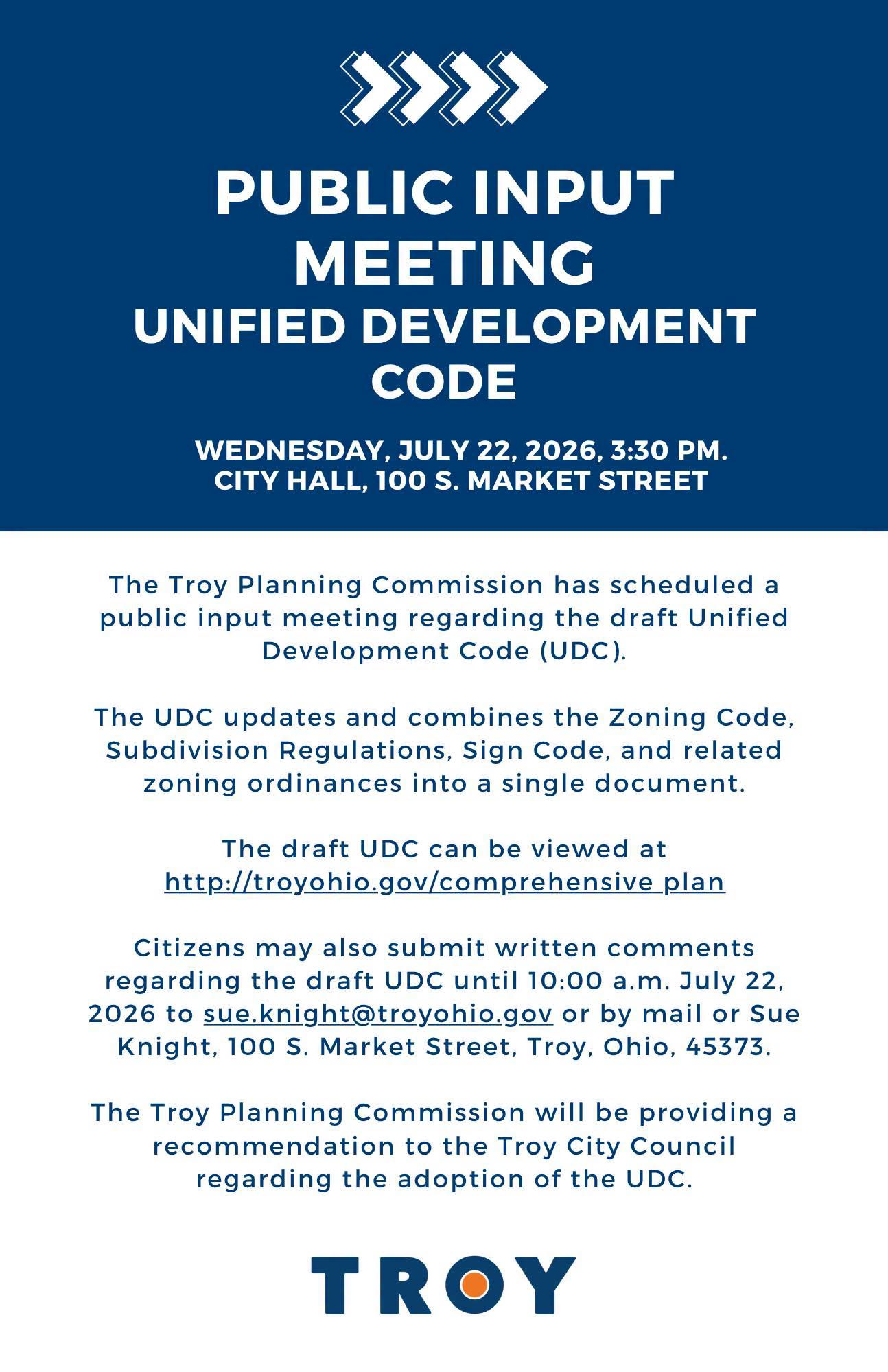
Troy’s Planning Commission meets this Wednesday, July 22 at 3:30 p.m., and public comment is welcome on the city’s draft Unified Development Code — the document that will govern what gets built where in Troy for years to come. If you’ve ever wondered why a gas station went up next to a school, or why a vacant storefront sits empty because the zoning won’t allow what a business owner wants to put in it, this is the meeting where those rules get written.
Why This Meeting Matters
The Unified Development Code (UDC) is a full rewrite that folds Troy’s zoning, subdivision, sign, and other land-development ordinances into one document. It replaces the city’s current patchwork of regulations — some dating back decades — with a single rulebook meant to guide “future growth and development” and to “protect and conserve the value of land, buildings, and other improvements”. Once adopted by City Council, this becomes the operating manual for every rezoning, every new subdivision, every drive-thru, and every corner store for the foreseeable future.
Wednesday isn’t a rubber-stamp session. Planning Commission held a workshop on July 8 and specifically asked staff to go back and rework two contentious sections of the code before this meeting. That means the draft in front of commissioners this week has real, substantive changes in it, and residents who show up have a chance to weigh in before those changes get locked into a recommendation to City Council.
What Changed Since The Last Meeting
A memo from the Development Department dated July 17th lays out staff’s proposed revisions in redline — additions in red text, deletions struck through — pending legal review. Two issues dominate the update:
Automobile fuel dispensing stations (gas stations). The original draft required a 50,000-square-foot principal building for a gas station to be permitted outright. Staff now proposes cutting that threshold to 10,000 square feet, and — more significantly — allowing fuel stations only as an accessory use to a grocery store or restaurant, with at least 51 percent of the building dedicated to that grocery or restaurant use. Staff also proposes requiring fuel canopies to sit in the rear yard (removing the previous cap on the number of pumps), adding a 2,000-foot separation requirement between competing stations, and adopting the American Planning Association’s definitions of “grocery” and “restaurant” to tighten up who actually qualifies. Under the current draft UDC, standalone gas stations as a primary use remain outright prohibited citywide regardless of zoning district .
Tattoo parlors. The draft UDC as it stands lists tattoo parlors among a short roster of citywide prohibited uses — alongside adult cannabis operators, casinos, manufactured home parks, and commercial solar and wind energy systems . Staff’s new proposal would remove tattoo parlors from that prohibited list entirely and instead allow them only as an accessory use tied to a principally permitted barber shop or beauty salon. That’s a meaningful shift — from a flat ban to a conditional allowance — and it’s exactly the kind of judgment call that benefits from resident input before it’s finalized.
What’s Still Open for Debate
Beyond the two headline items, the broader prohibited-uses list is worth a hard look, because it applies citywide regardless of what zoning district a property sits in. As drafted, the code bars: adult-use cannabis operators, casino gaming centers, commercial truck parking lots, manufactured homes and manufactured home parks and sales, recreational vehicle parks and campgrounds, skill-based amusement centers, commercial-scale solar energy systems, and commercial-scale wind energy systems, in addition to gas stations as a primary use and tattoo parlors as currently written .
A few of these deserve resident scrutiny beyond the two staff already flagged:
Commercial solar and wind energy systems are banned outright citywide, which forecloses on-site renewable energy projects for local businesses or institutions even in industrial districts — worth asking staff why no zoning district permits these uses, even with conditions.
Manufactured homes, manufactured home parks, and manufactured home sales are prohibited citywide, which residents concerned about housing affordability may want to raise, since manufactured housing is often a lower-cost ownership option.
Skill-based amusement centers and commercial truck parking lots round out the list — the kind of uses that rarely generate public comment until after they’ve been permanently foreclosed.
There’s also a structural feature of the code worth understanding: if a proposed use isn’t specifically listed anywhere in the land-use tables, the Development Code Administrator decides whether it’s similar enough to an existing permitted use to be allowed — and if not, it’s automatically prohibited. That “if not authorized, then prohibited” default puts a lot of discretion in staff hands for uses nobody has thought of yet, and it’s a fair question to raise Wednesday: what happens when a genuinely new type of business shows up in Troy that doesn’t fit neatly into 2026’s categories?
How to Weigh In
The Planning Commission has already shown, in going back to staff after the July 8 workshop, that public and commissioner feedback changes the draft in real time. That’s the entire point of showing up Wednesday: this code is not finished, and the areas still marked in red and strikethrough are the areas most open to being shaped by the people who actually live and do business in Troy.
If gas station placement near your neighborhood, the tattoo parlor accessory-use compromise, or the citywide bans on manufactured housing or renewable energy systems matter to you, Wednesday at 3:30 p.m. is the moment to say so — before this draft moves to City Council for final adoption.
Announcing our July Community Survey!
Every other month, this publication takes time to ask our readers how they feel about the happenings in their hometown! What are the challenges? What are the opportunities? Is your hometown headed in the right direction? Our survey is the easiest way for you to express your thoughts. Next month, this publication will report out on the results.
Thanks for your time and your participation! It is greatly appreciated!
This is what it looks like when residents stay informed. If you find value in this work, share it with a neighbor, a colleague, or anyone who cares about this community. Paid subscriptions keep it going — $5 a month.
Civic Capacity runs on one thing: readers who believe local journalism matters. If you want to support this work without a subscription, you can now make a one-time contribution through Buy Me a Coffee — or in my case, Buy Me an Iced Tea. Click the button below. Every contribution goes directly into the work you read here every day.