

What is a TIF District?
Vol. IV, No. 37 - Taking a Step Back to Explain Tax Increment Financing

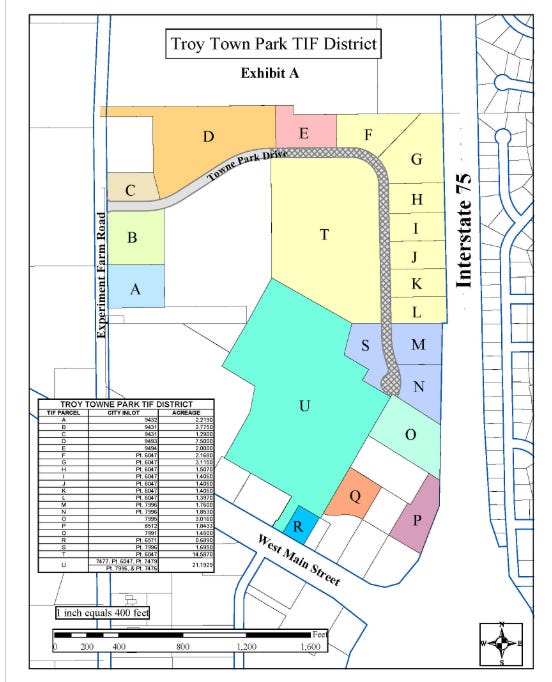
One part of the West Main Street/Experiment Farm Road project hasn’t received much attention: how it’s actually being paid for.
Whether the final design ends up being a roundabout or an upgraded signalized intersection, the funding matters just as much as the layout. These projects don’t happen without a financing strategy behind them.
In this case, most of the funding will come from a grant through the Miami Valley Regional Planning Commission. But a significant portion is coming from the City’s Tax Increment Financing (TIF) fund.
Which raises a fair question: what exactly is Tax Increment Financing?
It’s one of those terms that gets thrown around, but it’s rarely explained. It’s local government inside jargon that often leaves residents confused about what is really happening with local revenues.
At its core, a TIF only deals with property taxes. Every parcel in the county has an assessed value—even if it isn’t currently taxed, like certain government-owned properties, or if it’s undeveloped land such as farmland.
Here’s how it works.
A city creates a TIF district, usually made up of undeveloped or underdeveloped land. When that district is established, the existing property tax value is essentially “frozen.” All of the overlapping taxing entities—schools, libraries, townships, the county—continue to receive the same level of revenue they were getting before any development occurs.
But once development happens and property values increase, the additional taxes generated above that original base—the “increment”—are set aside. Those dollars go into a dedicated Tax Increment Financing fund.
That money is restricted. It doesn’t go toward general government services. Instead, it can only be used for improvements that directly benefit the district—things like roads, sidewalks, utilities, and other supporting infrastructure.
This is where TIFs become attractive.
For developers, a TIF district helps ensure that the new tax revenue generated by their project is reinvested back into the area, improving access and infrastructure that supports their development.
For cities, TIFs create a dedicated funding stream for infrastructure in areas targeted for growth—without having to rely entirely on existing tax revenues or new tax increases.
And that brings us back to West Main Street and Experiment Farm Road.
When you see TIF dollars being used on a project like this, it’s a signal that the area has been identified as a growth corridor, and that past or anticipated development is generating the revenue to support these kinds of improvements.
That doesn’t make it good or bad on its own—but it does make it worth understanding. Because once a TIF district is in place, it shapes how future tax dollars are collected, allocated, and reinvested—often for decades.
And in many cases, those decisions happen with far less public discussion than the projects they ultimately fund.
This is what it looks like when residents stay informed. If you find value in this work, share it with a neighbor, a colleague, or anyone who cares about this community. Paid subscriptions keep it going — $5 a month.
This Month, we are doing something different! We are partnering with the Troy-Miami County Public Library by using this platform to raise funds for the Dolly Partin Imagination Library locally here in Miami County! Through the Dolly Partin Imagination Library, children from birth to Kindergarten, can get a book delivered every month to their home at no cost.
And while Dolly is a huge help, she picks out the stories and she works with the publishers, there is still a local cost to the program. Your donations through our “Buy Me A Coffee Page” will help get these youngsters on the right track to a life-long love of reading!
Thanks to John And Kim, Rachelle. Loraine S., Loraine W., and a special anonymous donor, for your recent donations to this effort. So far this month — 71 books have been purchased! Thank you!