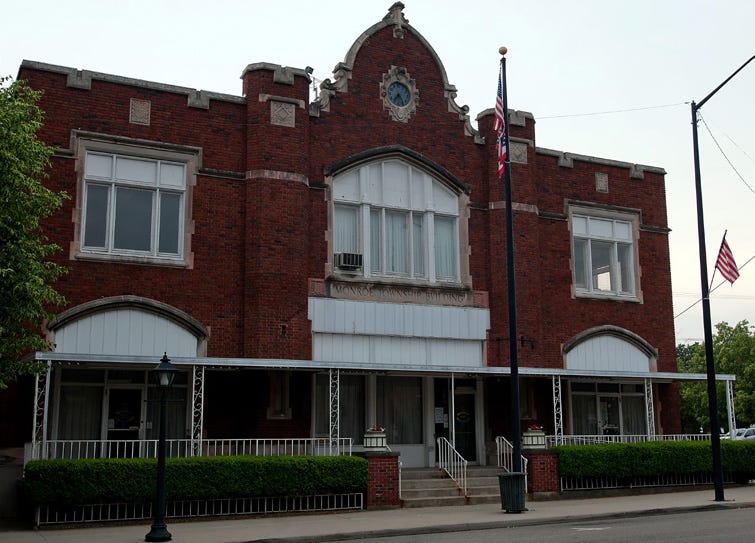
What is a Township?
Vol. III, No, 195 - These small forms of local government are the quiet cornerstone of Ohio's local government landscape
It is one of the most diverse and interesting forms of local government in Ohio. There are more than 1,300 of these units altogether in Ohio, most carved out of neat squares of roughly thirty-six square miles when the state was first surveyed. But the numbers only tell part of the story. These townships can serve populations as small as ninety-seven or as large as sixty-three thousand—all operating under the same form of government to meet their residents’ needs.
Some states have them as a functional part of local government, like here in Ohio and neighboring Michigan, and in some states, they are just a unit of land surveying, like in Oklahoma. Regardless, townships are really the foundation of local government here in Ohio.
Township government in Ohio is even closer to everyday life than the county. You might not think about it until a snowplow clears a rural road, a cemetery fence gets repaired, or a drainage ditch gets cleaned out. Yet these small acts of maintenance, order, and local democracy trace their lineage through centuries of civic practice—back to the earliest American communities, and long before that to the traditions of local self-rule in England and New England.
The township’s story begins alongside the county’s, but its spirit is older, more local, and more personal. While the English shire was built for royal oversight, the township grew from the bottom up. Medieval “tuns,” or farmsteads, banded together for common purposes—maintaining roads, tending to the poor, and keeping the peace. These early “town meetings” were not formal governments so much as organized communities, living models of neighbors solving problems together.
When English colonists crossed the Atlantic, they brought both systems—shire and town—with them. In the southern colonies, the county dominated; in New England, the town did. New England towns valued self-governance above all: voters gathered in open meetings to decide budgets, laws, and officers. That ideal of local control resonated deeply with settlers heading west into the Northwest Territory. When Congress passed the Northwest Ordinance of 1787, it blended these models into one framework—counties layered over townships. As the Ordinance guided settlement into what became Ohio, that structure took root statewide: each county subdivided into townships. Early forms of township government would have constables and justices of the peace along with trustees and a clerk.
For early Ohio settlers, the township was the simplest and most familiar form of government—close enough to touch. Township meetings handled fence disputes, road maintenance, and all the practical work of keeping frontier life orderly. Trustees served as both public managers and local mediators. The position carried authority but rested entirely on reputation: trustees were often farmers, merchants, or craftsmen whose standing in the community gave their word weight.
Over the decades, Ohio law formalized the township’s powers while preserving its small scale. Today, Ohio’s 1,308 townships are governed by three elected trustees and one elected fiscal officer. Together they oversee budgets, roads, cemeteries, parks, fire protection in unincorporated areas, and—where adopted—local zoning. Their meetings are still public, their budgets still approved locally, and their accountability still direct. Financially, most depend on local levies and county or state partnerships, a visible reminder of the township’s enduring balance between independence and cooperation.
In suburban regions, some townships have transformed almost beyond recognition. City growth and suburban expansion have turned once-rural areas into communities of thousands, complete with shopping centers, subdivisions, and professional administrative staff. In rural Ohio, others remain much as they were—volunteer-led, tied to farmland and churchyards, quietly tending to the civic life of the countryside.
Despite these differences, every Ohio township embodies the same principle: that people can govern themselves in small, practical, human-scale ways. It’s a principle so ordinary that we often overlook it, yet it remains one of Ohio’s most democratic traditions. If the county connects us to the machinery of the state, the township connects us to one another. It shows how self-government begins not in grand halls, but around local meeting tables—still, after two centuries, government of the people, by the people, and for the people, right where they live.
A New Handbook to grow Civic Capacity!
Recently, we created a new digital handbook, “The Citizen’s Guide to Public Records”. This handbook is designed to help residents have a better understanding of public meetings and meeting records. It’s filled with templates, ideas and other information that will open a new world of public affairs.
Also, if you have ideas for future handbooks, please let us know at pinnaclestrategiesltd@gmail.com.
Want to Learn More About Troy’s Businesses?
Our publication has recently released our September 2025 Economic Abstract, the most comprehensive and up-to-date report on the businesses and industries in the City of Troy. For those that want to understand our community’s business and industries, this is a must-have report.
Thank you to our New Media Partners!
Recently, many of our stories has been showing up on the local news website, www.mymiamicounty.com. We are grateful for the good folks for sharing our work with their audience and we would encourage our readers to check them out at their website!
Our publication would also like to recognize the good work being done at www.piquanewsnow.com. Piqua News Now is a new web-based news and information site for the Miami County area, with a specific focus on Piqua!
In addition, the good folks at Piqua News Now have started a new, 24-hour streaming YouTube channel. This channel is awesome with continuous weather updates and more importanly, it provides a 24-hour audio feed from county wide dispatch. Check it out here!
You Can Help Support This Work!
Our readers and subscribers have been asking for a new way to support the work being done here at Civic Capacity! Some of our readers do not like the idea of having to sign up for another subscription service. Some of our subscribers occasionally want to give more support through a one-time transaction.
Civic Capacity is partnering with “Buy Me A Coffee” to give our readers, subscribers and friends an opportunity to give one-time support to Civic Capacity. Personally, I don’t like coffee, but I will never turn down a nice iced tea. If you feel compelled to support this effort, just click the button below. In other words, this is an online tip jar.
Also, thanks for reading today’s Civic Capacity Newsletter! Please feel free to share this information with your friends and neighbors.
Also, please consider subscribing to our work. If you are a free subscriber, please consider becoming a paid subscriber. For less than $1 a week, you can get timely and conversational updates about the decisions that are impacting you and your community!


