


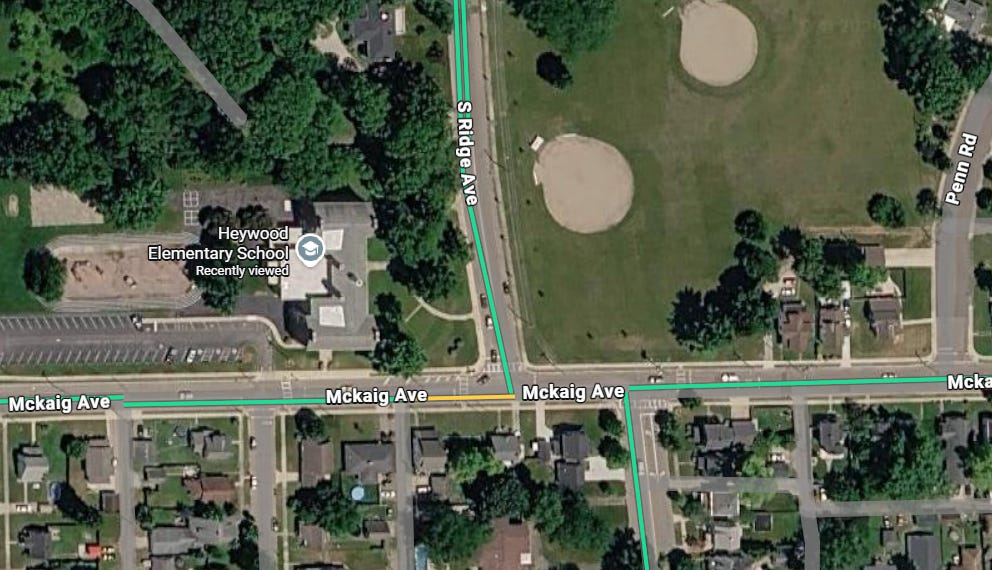
Back in April, this newsletter raised a simple question about the intersection of McKaig Avenue and Ridge Avenue: why is a fix for this intersection being discussed now, and does the data actually support it? The question was asked because when a City Council member talked about the future of the Heywood School building, this intersection came up in passing. You can read about that simple quetsion that was put forward back in April here:
If It Ain't Broke, Let's Fix It

Something interesting came up at last Monday’s Troy City Council meeting — and it’s worth talking a few minutes to discuss.
This coming Monday, City Council’s Streets and Sidewalks Committee will be asked to recommend that the Director of Public Service and Safety be authorized to apply to the Ohio Public Works Commission for funding to realign the McKaig and Ridge intersection. The pre-design estimate is $1,650,224, with the city requesting $600,000 in OPWC funds. Designing the intersection would begin in 2027, with construction following in 2028. The committee meeting, along with other council committees, will start Monday at 6:00 p.m. at the City Building.
The request from City Staff to the Committee backs up two things that came out of that April council meeting. First, the connection to Heywood School is now official, not just something raised in comments. The memo states plainly that “with the planned demolition of Heywood School,” the realignment “will also help to provide greater flexibility in the redesign and reuse of the properties.” Second, the timeline holds up. Staff described this as something that’s been “on the drawing board” for five to ten years, and a design start in 2027 with construction in 2028 fits that description.
The memo also gives us a number we didn’t have in April: the total project cost. At $1.65 million, with the city on the hook for roughly $1 million of that even if the OPWC grant comes through, this is a bigger commitment than a simple intersection tweak. Part of that cost is a sanitary lift station upgrade bundled into the same project, which is a reasonable thing to combine but worth residents knowing is in there.
What’s Still Missing
Curiously, the memo doesn’t mention a real need for this improvement, It doesn’t cite crash data from the Troy Police Department’s 2025 Annual Report, and it doesn’t address whether McKaig and Ridge shows up anywhere near the city’s actual crash hotspots. The justification offered is about “unnecessary delays and confusion in travel,” a subjective judgement, not a documented safety risk.
A funding application to OPWC is a specific kind of document, and perhaps it’s reasonable for it to focus on the case OPWC wants to hear. But it does mean the safety question we raised in April is still an open one heading into Monday’s committee meeting. If there’s crash data or engineering analysis behind the “poorly engineered” description we heard back in the spring, this would be a good time for it to surface.
And perhaps, more important to the residents of the neighborhood, is what is a discussion of what happens to the ball diamonds and open space at the intersection. For years, kids have practiced at these ball diamonds and there is no discussion of how the loss of this public park infrastructure is going to be made up elsewhere.
One more detail worth flagging: the memo asks Council to consider emergency legislation because of an October 9th application deadline. Emergency legislation in Ohio moves fast, with less time built in between when it’s introduced and when it passes. Given a project with a decade of history behind it, a fast final vote isn’t unreasonable on its own. But it does mean Monday’s committee meeting is likely to be the fullest public conversation this project gets before Council acts.
If you live near McKaig and Ridge or you’ve got thoughts on the ball diamonds, the intersection, or the $1 million local share, Monday at 6:00 p.m. at the City Building is where that conversation happens and it may be the only conversation we have on this issue.
This is what it looks like when residents stay informed. If you find value in this work, share it with a neighbor, a colleague, or anyone who cares about this community. Paid subscriptions keep it going — $5 a month.
Civic Capacity runs on one thing: readers who believe local journalism matters. If you want to support this work without a subscription, you can now make a one-time contribution through Buy Me a Coffee — or in my case, Buy Me an Iced Tea. Click the button below. Every contribution goes directly into the work you read here every day.